
Thule Spring
Price verified Sep 23, 2026
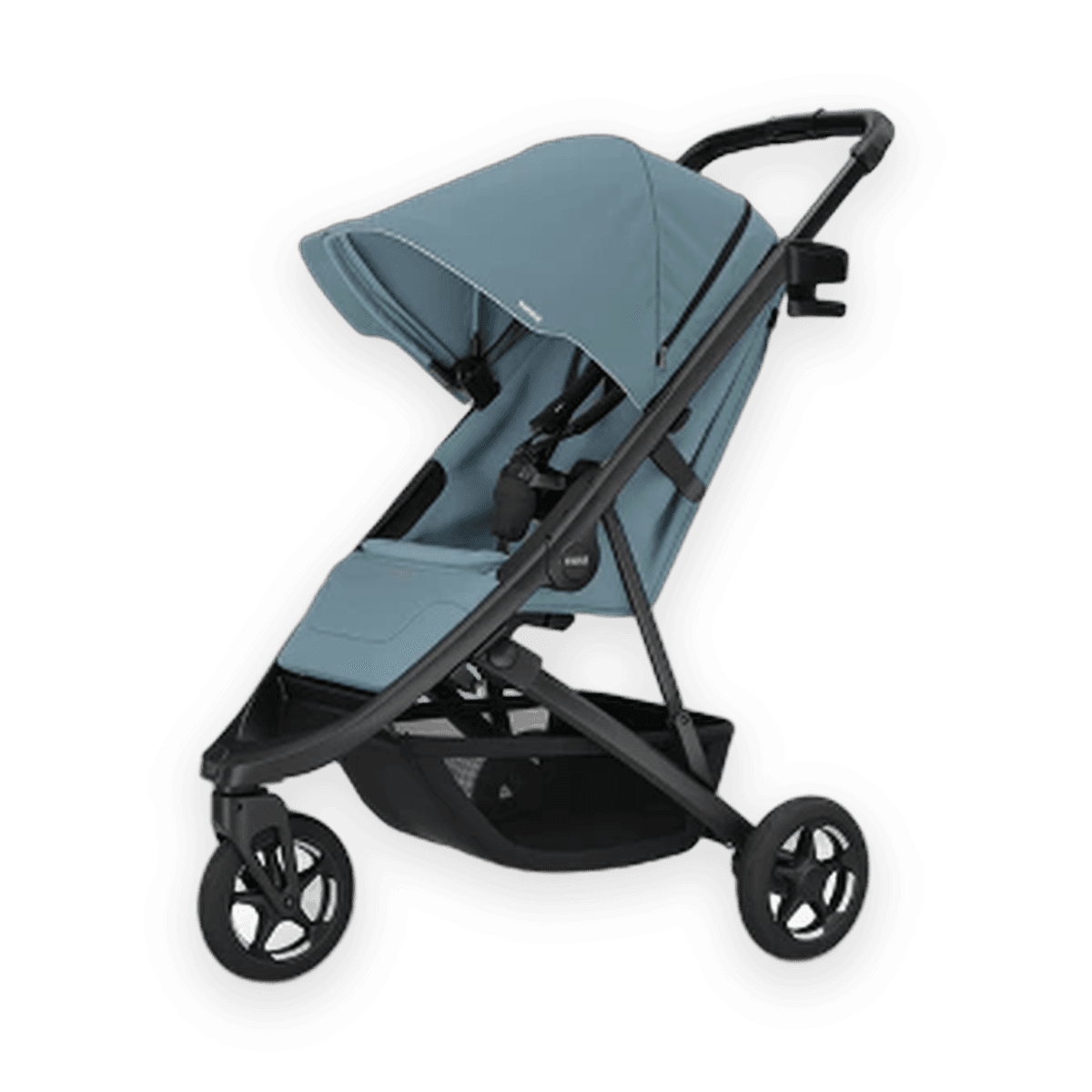
Product image via Target
Where to buy
Prices checked Sep 23, 2026- AmazonBest pickCheck price at Amazon
- TargetCheck price at Target
We may earn a commission from links on this page, at no extra cost to you. How this works.
13 min read · Reviewed by Huggle Hive Editorial Team, Parent-led product research team · Updated August 22, 2026
The Thule Spring is a compact all-terrain stroller for parents who walk real ground: cracked sidewalk, park gravel, packed dirt, the grass between the car and the picnic table. It has suspension, all-terrain capability, a five-point harness and a UPF 50 canopy, and it folds with one hand into a package that stands up by itself. If you want one stroller that handles rough surfaces without the size of a jogging stroller, this is a strong pick.
Our scorecard
How the Hive Score works- Portability
- 5.0
- Safety basics
- 4.4
- Comfort & ride
- 5.0
- Versatility
- 3.6
- Value
- 4.1
Scores blend each product's verified specs with its overall owner rating, weighted the same way for every stroller. Learn more about our evaluation framework.
Key takeaways
- All-terrain wheels plus suspension, so uneven ground is part of the design rather than an afterthought.
- One-hand fold that is self-standing, which matters every single time you load a car or step into an elevator.
- Newborn-ready with bassinet and travel-system compatibility, so it can start at the infant stage and keep going.
- Five-point harness, foot brake and a UPF 50 canopy cover the safety and sun basics.
- Single seat only, with no second-seat option, so growing families will outgrow the frame before the baby outgrows the ride.
Pros
- All-terrain build with suspension for gravel, grass and broken pavement
- One-handed, compact fold that stands on its own once folded
- Newborn-ready, with both bassinet and travel-system compatibility
- Five-point harness and a foot brake, the two safety basics you want on a daily stroller
- UPF 50 canopy for sun coverage on long walks
- Adjustable handlebar, which helps when two adults of different heights share the push
- Cup holder or tray included rather than sold separately
Cons
- One seat, with no second-seat or sibling configuration
- Thule lists the age stage as 6 months and up, so newborn use depends on adding a bassinet or an infant car seat
- Certification details such as JPMA or GREENGUARD Gold are not confirmed in the verified specs
- Foot brake rather than a hand brake, which is worth knowing if you push on steep hills
Who is the Thule Spring for?
You live somewhere the sidewalk runs out. Maybe it is a gravel trail behind the neighborhood, a park path that turns to dirt after the parking lot, or a city block where the pavement heaves up around tree roots. That is the parent this stroller is designed for: all-terrain capability and suspension are both confirmed on the spec sheet, and they exist to keep small wheels from catching and to soften what the frame passes up to your baby.
It also suits the parent whose stroller lives in a car trunk. The fold is one-handed and compact, and the folded frame is self-standing. That combination sounds minor until you are holding a baby in one arm at 7am. A stroller that stays upright on its own does not fall flat in a parking lot, does not need a wall to lean on, and does not need two free hands.
Skip it if you are having a second baby soon. The Spring has one seat, and there is no second-seat or ride-along configuration in the verified specs. Families planning close-in-age siblings should shop double or convertible frames from the start rather than buying twice.
Newborn parents sit in an interesting middle. Thule lists the age stage as 6 months and up, and it also lists the stroller as newborn-ready, bassinet-compatible and travel-system compatible. Read together, that points to a frame that accepts an infant on day one through a bassinet or a compatible infant car seat, with the seat itself intended for a baby who has real head and trunk control. If you want newborn use, budget for the bassinet or the car seat adapter and treat that as part of the purchase, not an upgrade for later.
Performance
How does it handle rough ground?
All-terrain and suspension are two separate attributes, and the Spring has both. That distinction matters more than most spec sheets let on. All-terrain capability is about the wheels and the frame keeping their line on loose or uneven surfaces instead of stopping dead at a lip of concrete. Suspension is about what happens after: how much of that jolt travels up into the seat where your baby is sleeping.
A stroller with one and not the other is a compromise. Wheels that roll over gravel with no suspension pass every bump straight through. Suspension on a frame with small, hard wheels never gets the chance to do its job because the wheels stop first. Having both is why we would put this ahead of a flat-pavement compact stroller for anyone whose daily walk includes a park.
A stroller that only works on smooth concrete quietly shrinks where you are willing to go. All-terrain plus suspension is what keeps the trail on the list.
One caveat worth stating plainly: all-terrain is not the same as jogging-rated. The specs here confirm all-terrain capability and suspension. They do not confirm a running or jogging rating, so we would not use it for running.
Is the fold actually easy?
Three attributes stack here, and together they describe a stroller you can operate while holding a baby. The fold is one-handed. The fold is compact. The folded stroller is self-standing.
Think about the actual sequence at a car. You unclip your baby, hold them on your hip, and now you need the stroller gone. With a one-hand fold, that is one motion. With a self-standing fold, the stroller waits upright beside you instead of tipping onto wet asphalt while you open the trunk. Thule's own description points to the same use case, calling out the compact fold and car travel compatibility as reasons the Spring suits on-the-go parents.
Compact is also a storage claim, and it is the one first-time parents underestimate. Strollers get stored in apartment entryways, coat closets and under stairs. A frame that folds small and stands up takes a footprint rather than a wall.
What are the safety basics?
The harness is five-point, which is the standard you want. A five-point harness holds at both shoulders, both hips and between the legs, so a baby who has learned to lean, twist and push cannot slide down or climb up. Three-point harnesses still exist on lightweight strollers, and they are the thing to check before you buy anything cheaper.
The brake is a foot brake. That is the common design, and it works: you step down to lock, step to release. It is worth knowing rather than a mark against the stroller, though parents who push on long or steep hills sometimes prefer a hand-operated brake they can feather. The CPSC's guidance on carriages and strollers is a good general read on brake and harness use, and the habit it reinforces is simple: harness your child every time, and set the brake every time you stop, even for a second.
Certifications are where we stop short. The verified specs for the Spring do not include a JPMA certification or GREENGUARD Gold, so we cannot tell you it carries either. That is a gap in what we can confirm and not a statement that the stroller lacks them. If certification is a decision point for you, ask Thule directly before ordering.
Does the canopy do enough?
The canopy is rated UPF 50. That number is a fabric rating, and it means the material is designed to block the large majority of UV that hits it. For a stroller this matters more than it does for most gear, because babies under 6 months should be kept out of direct sun rather than covered in sunscreen. The American Academy of Pediatrics' sun safety guidance for children puts shade and clothing first for infants, and a high-UPF canopy is the shade you carry with you.
The practical version: a UPF 50 canopy turns a stroller into usable shade on a morning walk, a farmers market, a sideline chair at an older sibling's game. It does not replace timing your walks around midday sun, but it removes the scramble for a tree.
What about the person pushing?
The handlebar is adjustable. This is the attribute parents skip past and then thank later. If two adults of different heights share the stroller, a fixed bar forces one of you to walk hunched or with your wrists bent up. Over a mile, that is a sore back or a sore shoulder. An adjustable bar means both of you push at your own natural height.
A cup holder or tray is included. Small, real, and one fewer accessory to buy.
How long will it last?
| Stage | How the Spring fits |
|---|---|
| Newborn | Newborn-ready via bassinet or a compatible infant car seat through the travel-system attachment |
| 6 months and up | The listed age stage for the stroller seat itself |
| Toddler | Five-point harness and all-terrain wheels keep it useful well past the first birthday |
| Second child | Not covered; one seat, no sibling configuration |
The honest read on longevity: this is a long-run stroller for one child and a short-run stroller for a growing family. Travel-system and bassinet compatibility mean you can start at the hospital discharge stage with the right attachment, and the stroller seat carries on from around 6 months. What it does not do is convert. When a second baby arrives, you are shopping again.
What you are actually paying for
Strollers in this class are priced for the frame, not the fabric. Here is where the money goes on the Spring, based on the confirmed specs:
- Suspension and all-terrain wheels. The most expensive thing on the list, and the reason it costs more than a flat-fold umbrella stroller.
- The fold mechanism. One-handed and self-standing folds require engineering that budget frames skip.
- Compatibility hardware. Bassinet and travel-system support is what lets one frame serve a newborn and a toddler.
- The canopy. UPF 50 fabric is a material spec, not a marketing line.
- Adjustable handlebar and included tray. Convenience items that are often paid extras elsewhere.
Running cost on a stroller is close to zero after purchase, which makes the buying decision different from a consumable like diapers. What you are really weighing is years of use per dollar. A frame that covers newborn through toddler for one child spreads its cost across roughly three years of near-daily use. A frame that gets replaced when a sibling arrives spreads it across fewer.
How it compares to other stroller types
We do not have direct peer data for the Spring in our catalog yet, so here is the type-level comparison that actually drives the decision.
Versus a full travel system. Travel systems bundle an infant car seat with a frame and usually win on out-of-the-box newborn readiness and price. They tend to lose on wheels. If your walks are all smooth pavement and parking lots, a travel system is the value play. If they are not, the Spring's suspension and all-terrain build are the reason to spend more.
Versus a jogging stroller. Joggers have larger wheels, often a fixed front wheel for running, and a much bigger folded footprint. The Spring is the compact answer to the same terrain problem. Choose the jogger if you run. Choose the Spring if you walk far but store small.
Versus a lightweight compact stroller. Umbrella-style compacts fold smaller and cost less, and many use a three-point harness with hard, small wheels. They are travel strollers. The Spring is a daily driver that happens to fold well.
How we scored it
The Spring earns an 8.6 Hive Score, and the sub-scores explain the shape of it.
Portability lands at 5.0. Three attributes push it there: the one-hand fold, the compact fold and the self-standing folded frame. There is nothing left to ask for in this dimension.
Comfort and ride also hits 5.0. Suspension, all-terrain capability, the UPF 50 canopy and the adjustable handlebar all feed this score, and the Spring has every one of them. It covers comfort for the baby and comfort for the adult pushing.
Safety basics sits at 4.4. The five-point harness lifts it. What holds it short of the top is that our verified data does not confirm a JPMA certification or a GREENGUARD Gold rating. Not confirmed is not the same as absent, and the score reflects what we can verify rather than a judgment that anything is missing.
Versatility comes in at 3.6, the lowest of the five. Travel-system compatibility, bassinet compatibility and newborn readiness all count in its favor. The single seat is what caps it. This dimension rewards frames that stretch across children and configurations, and the Spring is built for one child at a time.
Value lands at 4.1. The feature set is dense for a compact stroller, particularly the suspension, the canopy rating and the included tray, which keeps value strong even before the score is nudged by the overall rating.
Our full review methodology explains how these dimensions are defined and weighted. Sub-scores are computed from the verified attributes, not written by hand.
Can you use the Thule Spring from birth?
It is listed as newborn-ready and it is compatible with both a bassinet and a travel system, so it can carry an infant from the start with the right attachment. Thule lists the stroller's own age stage as 6 months and up, so plan on a bassinet or a compatible infant car seat for the newborn months.
Is the Thule Spring good for rough terrain?
Yes. It is an all-terrain stroller with suspension, which is the combination that handles gravel, grass and uneven sidewalk. It is not confirmed as a jogging stroller, so we would not use it for running.
Does it fold with one hand?
It does, and the folded stroller is self-standing. That means you can fold it while holding your baby and it will stay upright next to you instead of falling over.
What kind of harness does it have?
A five-point harness, which secures both shoulders, both hips and between the legs. That is the standard to look for on a daily stroller, especially once your baby starts leaning and pushing against the straps.
Does the canopy protect against sun?
The canopy is rated UPF 50. Pediatric guidance puts shade first for babies under 6 months, so a high-UPF canopy is doing real work on a sunny walk.
Can it hold two children?
No. The Spring has one seat and no second-seat configuration in its verified specs. If a second child is coming soon, look at double or convertible frames instead.
Where can you buy the Thule Spring?
Check current availability using the retailer links below, and compare it against the rest of our stroller coverage before you commit.
Where to buy the Thule Spring
Availability moves around on strollers more than on most baby gear, and color options come and go faster than the model itself. Check current stock and pricing through the Thule stroller lineup before you decide, and compare it against the rest of our stroller reviews if you are still weighing frames.
Bottom line
The Thule Spring is a compact all-terrain stroller that does not make you choose between rough ground and easy storage. Suspension and all-terrain capability handle the surfaces a flat-fold compact cannot, and the one-hand, self-standing fold makes it workable with a baby on your hip. Add a five-point harness, a UPF 50 canopy, an adjustable handlebar and travel-system plus bassinet compatibility, and you have a frame that can start at the newborn stage and stay useful into the toddler years.
The trade-off is the seat count. One child, one seat, no sibling setup. If your family is done growing or your second is years away, this is an easy recommendation. If another baby is close behind, put your money into a frame that can carry both.
Thule Spring
See prices