
Jovial Portable Folding Stroller JPC20
Price verified Sep 19, 2026
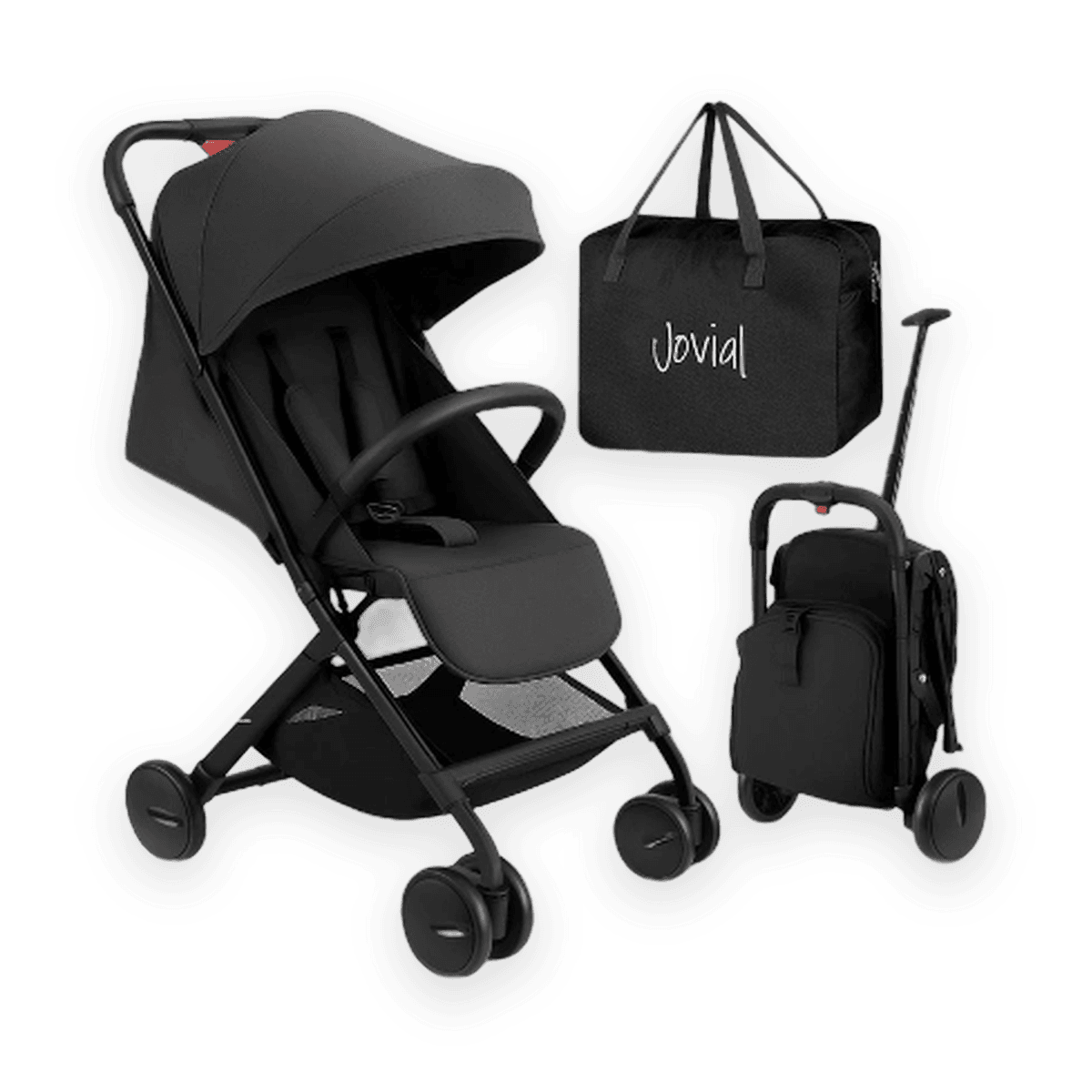
Product image via Target
Where to buy
Prices checked Sep 19, 2026- TargetCheck price at Target
We may earn a commission from links on this page, at no extra cost to you. How this works.
16 min read · Reviewed by Huggle Hive Editorial Team, Parent-led product research team · Updated August 3, 2026
Jovial's Portable Folding Stroller (model JPC20BK) is a 16.3 pound aluminum stroller with a one-hand fold, a five-point harness, and a 35 pound weight limit. Buy it for the fold and the trunk math. Skip it if you want a frame that adapts into a travel system or lies flat for a newborn, because neither capability appears in the verified specs.
Our scorecard
How the Hive Score works- Portability
- 4.4
- Safety basics
- 3.8
- Comfort & ride
- 4.2
- Versatility
- 2.4
- Value
- 3.7
Scores blend each product's verified specs with its overall owner rating, weighted the same way for every stroller. Learn more about our evaluation framework.
The Jovial JPC20 at a glance
- One-hand fold on a 16.3 pound aluminum frame. The fold is the feature you are actually buying.
- Folded size is 10.6 by 18.9 by 22 inches, roughly 2.6 cubic feet, which leaves room in a sedan trunk for groceries.
- Five-point harness, not a three-point belt, so a toddler who has learned to lean forward stays seated.
- Rated to 35 pounds and pitched at 0 to 3 years: a three-year stroller, not a buy-it-once frame.
- A short flight of stairs on one arm is fine. A daily walk-up with your baby in the other arm is where 16.3 pounds tells.
- Hive Score 7.4 out of 10, pulled down by versatility (2.4 out of 5) more than by anything the stroller does badly.
The good and the frustrating
Pros
- One-hand fold is confirmed in the specs, which is the difference between folding at the curb with a baby on your hip and needing both hands and a free minute.
- Folds to about 2.6 cubic feet, small enough for a small-car trunk, a coat closet, or the gap behind a front seat.
- Five-point harness spreads restraint across both shoulders, both hips, and the crotch strap.
- Aluminum frame holds the weight to 16.3 pounds, comfortably under the 20 pound line where a lightweight stroller stops feeling lightweight.
- 35 pound capacity paired with a 0 to 3 year age stage covers most of the stroller years for an average-sized child.
- One year warranty from the brand.
Cons
- 16.3 pounds is lightweight, not featherweight. The lightest one-hand-fold travel strollers sit under 14 pounds.
- No travel system compatibility, reversible seat, or bassinet appears anywhere in the specs, which caps how the stroller adapts.
- Recline depth is unpublished, and that is the single number a newborn parent needs most.
- Suspension, a canopy UPF rating, and an adjustable handlebar are all absent from the spec sheet.
- Open height of 32.3 inches points to a handlebar on the lower side, which taller parents should measure before buying.
- JPMA certification is not listed. Treat that as unknown rather than as a failing grade.
- No confirmed price on file, so value has to be judged against whatever number you find it at.
Who it is for, and who should keep looking
Buy it if your bottleneck is storage or a second stroller. Small trunk, city apartment, grandparents' hall closet, the car that already holds a pack and play: this is the shape of buyer the JPC20 fits. A one-hand fold down to 2.6 cubic feet solves a specific daily annoyance, and it solves it on a frame that a five-point harness makes appropriate for a mobile toddler.
If you are shopping for a walking-age baby through the preschool stretch, the numbers line up. A 35 pound cap and a 0 to 3 year age stage mean you are buying roughly three years of use, and the aluminum frame keeps the whole thing at a weight most adults can lift into a trunk one-handed after a long day.
Keep looking if you are shopping newborn-first or buy-it-once. For a newborn, what you need is a deep recline (ideally flat) or bassinet compatibility, and the JPC20's specs say nothing about either. Unpublished is not the same as unsuitable, but you should not spend money on hope. Parents who want a single frame from hospital discharge through preschool are better served by a convertible full-size system such as the UPPAbaby Vista, which takes a bassinet and expands to two seats, or by a car-seat-and-stroller hybrid like the Doona if the priority is moving a sleeping newborn from car to sidewalk without a transfer. Check each of those against its own current listing before you buy; model years shift specs.
The fold is the product. Everything else is a competent, unadorned stroller frame, and the specs are honest about that.
Performance
How portable is it, really?
Here is our shorthand for the category, because "lightweight" gets used for almost everything. Under 14 pounds is featherweight, the cabin-bag class the Babyzen Yoyo2 defined. Fourteen to 20 pounds is genuinely lightweight. Over about 22 pounds is full-size, where you get suspension and travel-system hardware and pay for it in lifting.
The JPC20 lands at 16.3 pounds, squarely in the middle band. That matters in both directions. Against a full-size stroller it is a meaningful five to ten pound saving every time you load the car. Against a true featherweight it is two to three pounds heavier, which you will not notice pushing and will notice carrying.
Folded, it measures 10.6 inches high by 18.9 wide by 22 deep. Multiply that out and you get about 2.6 cubic feet. A compact sedan trunk runs somewhere in the low teens of cubic feet, so the stroller takes up a fifth of it and leaves the rest usable. The 10.6 inch thickness is the number that matters for closet storage, since that is what determines whether it slides in beside the coats or blocks the door.
| Folded number | What it means for your week |
|---|---|
| 10.6 in thick | Slides flat against a closet wall or behind a front seat |
| 18.9 in wide | Narrower than most car trunk openings and standard doorframes |
| 22 in long | About carry-on length, though thicker through the middle, so confirm gate-check rules with your airline |
| ~2.6 cu ft total | Roughly a fifth of a compact sedan trunk |
The one-hand fold is confirmed, and it is the reason the portability score sits where it does. Whether the stroller stands on its own once folded is not in the data we can verify, so if you plan to park it upright in a hallway, look for that in the listing photos before you commit.
Is the harness enough?
Five-point, and yes, that is the right answer for this age range. Two shoulder straps, two hip straps, and a crotch strap keep a child from sliding down under a lap belt or standing up mid-push. Three-point belts still appear on cheap umbrella strollers, and they are the main reason we would not recommend most of them past the sitting-still stage.
What we can confirm ends there. JPMA certification and a GREENGUARD Gold rating are not part of the verified specs, which means unknown, not absent. Strollers sold in the US have to meet the federal stroller rule (16 CFR 1227, which incorporates the ASTM F833 standard) covering things like restraint strength, brake performance, and folding-latch integrity, so a compliant stroller clears a real bar even without a voluntary certification badge on the box. If third-party certification is a decision point for you, JPMA's certification database is the place to verify rather than assume, and the CPSC recall list is worth a search on any stroller before checkout, including this one.
One habit worth building regardless of model: harness your child every time, including for the thirty second push from the car to the front door. Most stroller injuries reported to regulators involve falls, and an unbuckled child in a folded-position moment is how they happen.
Comfort and ride
Comfort and ride lands at our category baseline for a lightweight aluminum stroller, and nothing in the spec sheet moves it up. Suspension, a canopy UPF rating, all-terrain wheels, and an adjustable handlebar are the four features that normally lift this score, and none of them appear in the verified data.
What you can reason about is the geometry. Open, the stroller measures 32.3 inches high by 18.7 wide by 39.8 deep. That 18.7 inch width is genuinely narrow, which means aisles, apartment doorways, and cafe tables stop being obstacle courses. The 39.8 inch depth is average for a single stroller, so it will not swing wide in a turn.
The 32.3 inch height is the one to think about. On most strollers that figure is measured at the handlebar, and 32.3 inches is on the low side for an adult over roughly six feet. Without a confirmed adjustable handle, taller parents may find themselves reaching down slightly on long walks. If you and your partner differ a lot in height, stand next to a tape measure at 32 inches before deciding.
A sub-17 pound aluminum frame with small wheels behaves the way that description suggests: pleasant on pavement and sidewalks, less so on grass, gravel, and packed sand. We would not point you here as a park-trail stroller.
Where versatility runs out
This is the weakest part of the picture, and it is worth being blunt. The specs list a single seat and give no indication of travel-system compatibility, a reversible seat, bassinet support, or a stated recline type. Every one of those is a thing manufacturers advertise loudly when it is true.
The practical result: this is a standalone stroller. Your infant car seat does not click onto it (unless the brand's own listing says otherwise, which ours does not show). Your baby faces away from you. If you have a second child later, you are buying a second stroller.
For a family who already owns an infant car seat with its own base and just wants something small in the trunk, that limitation costs nothing. For a first-time parent buying one stroller to cover everything, it costs a lot.
Fit and sizing: how long will it last?
Two numbers set the lifespan: a 35 pound child weight limit and a 0 to 3 years age stage. Those agree with each other reasonably well, since many children cross 35 pounds somewhere in the preschool years rather than during toddlerhood.
What this means in practice is that the stroller retires on weight, not on height, for most families. There is no listed seat height or canopy clearance, so a very tall three-year-old may outgrow the seat visually before hitting the cap. Watch for the classic signs: knees above the footrest, head pressing the canopy, shoulders above the top harness slots.
| Stage | Fit against the verified specs |
|---|---|
| Newborn (0 to 4 months) | Depends entirely on recline depth, which is unpublished. Verify before relying on it. |
| Sitting baby (5 to 12 months) | Comfortable territory. Five-point harness and a narrow frame both work in your favor. |
| Toddler (1 to 2 years) | The sweet spot. Light enough for constant in-and-out, restrained enough for a climber. |
| Preschooler (2 to 3 years) | Fine until the 35 pound cap, which is the hard stop. |
The pediatric guidance on positioning young infants for long stretches in semi-upright seats is worth a read if this would be your primary newborn setup; the AAP's parenting site is the plain-English source we would point you to.
What it costs to own
We do not have a confirmed price for the JPC20 on file, so we are not going to print one. What we can do is give you the test to apply to whatever number you find.
What you are actually paying for:
- A confirmed one-hand fold, the single most-used feature on any lightweight stroller.
- An aluminum frame at 16.3 pounds, which is a materials cost, not a marketing line.
- A five-point harness rather than the three-point belt on bottom-tier umbrella strollers.
- A 2.6 cubic foot folded package.
- A one year warranty.
What you are not paying for: suspension, travel-system hardware, a reversible or bassinet-ready seat, a rated canopy, or an adjustable handlebar. None of those are in the specs.
So the rule is straightforward. At budget pricing, well under a hundred dollars, that feature list is fair and the fold alone earns its keep. Premium travel strollers cost several times that, and they justify it with the exact features this one does not list. If the JPC20 is priced anywhere near that premium tier, the math stops working, because you would be paying compact-stroller money for compact-stroller capability only.
One cost that is easy to forget: if this is your only stroller and you have a newborn, you will likely also buy an infant car seat and possibly a second stroller later. Budget the system, not the item.
How it compares
We do not have verified head-to-head specs for peer strollers in this review, so treat what follows as category positioning rather than a spec comparison, and check any competitor against its own listing.
Against the featherweight class (under 14 pounds). The Babyzen Yoyo2 is the reference point here. Strollers in that band fold smaller and carry easier, which is what you want if you fly often or climb stairs daily. You pay a large premium for those two to three pounds. If your stroller mostly lives in a trunk, the JPC20's 16.3 pounds is the better spend.
Against a convertible full-size system. The UPPAbaby Vista sits at the other extreme: bassinet compatible, expandable to two seats, and heavy enough that you feel every trunk load. It is the buy-it-once answer for a family planning a second child. The JPC20 is the opposite philosophy, one job done cheaply and lightly.
Against a newborn-first hybrid. The Doona folds a car seat into a stroller so you never transfer a sleeping infant. It solves the first six months brilliantly and then ends. If that is your pain point, buy for it directly rather than hoping an unpublished recline angle will cover you.
If you want the wider field, our lightweight stroller guide ranks the compact-fold category, and the full stroller review index covers the full-size and travel-system tiers.
How we scored it
The JPC20 earns a Hive Score of 7.4 out of 10, the mean of five sub-scores. Here is where each landed and why.
Portability, 4.4 out of 5. The confirmed one-hand fold does most of the lifting, and the compact folded footprint supports it. The reason this is not a 5 is the weight: at 16.3 pounds it sits above the sub-15 pound threshold that earns a bump, and self-standing fold is not listed.
Safety basics, 3.8 out of 5. The five-point harness is the credit. This category starts below the others by design, because voluntary certification is where a stroller proves out beyond the federal minimum, and neither JPMA certification nor a GREENGUARD Gold rating is documented for this model. That gap is what keeps the score in the high threes rather than the mid fours.
Comfort and ride, 4.2 out of 5. This one sits at the category baseline. The four features that would push it higher (suspension, a rated UPF canopy, all-terrain wheels, an adjustable handlebar) are all missing from the spec sheet, so nothing lifted it, and nothing in the geometry drags it down either. The narrow 18.7 inch open width helps in tight spaces.
Versatility, 2.4 out of 5. The lowest score, and the honest one. This dimension builds up from a low base as a stroller adds travel-system compatibility, a reversible seat, newborn readiness, bassinet support, a second seat, or a stated recline type. The JPC20 documents none of them, so it stays near the floor.
Value, 3.7 out of 5. Value is anchored to price tier, and no tier is confirmed for this model, so nothing pulled the score up toward bargain territory or down toward premium. It sits mid-band. Apply the price test in the cost section above and adjust for yourself. Our full method is on the review methodology page.
Is the Jovial JPC20 safe for a newborn?
The listing gives an age stage of 0 to 3 years, but recline depth is not published in the specs we can verify, and recline is exactly what determines newborn suitability. A baby without steady head control needs a deep or flat recline. Ask the seller or check the manual for the recline angle before using it with an infant, and use your infant car seat in the meantime.
How much does it weigh, and can I carry it up stairs?
It weighs 16.3 pounds. A short flight on one arm is manageable for most adults. A daily walk-up with a baby in your other arm is where those pounds become the deciding factor, and a sub-14 pound travel stroller would serve you better.
What size child does it fit?
The maximum child weight is 35 pounds and the stated age stage is 0 to 3 years. Weight is the hard limit. Watch also for knees past the footrest and shoulders above the top harness slots, which can arrive before the weight cap does.
Will it fit in a small car trunk?
Folded it measures 10.6 by 18.9 by 22 inches, about 2.6 cubic feet. That is roughly a fifth of a compact sedan trunk, so it fits with room left for shopping. The 10.6 inch thickness also makes it easy to store flat in a closet.
Can I attach an infant car seat to it?
Travel system compatibility is not listed in the verified specs, so we would plan on no. If a seller claims otherwise, ask for the specific adapter part number before buying.
Is it JPMA certified?
Not according to the specs we can verify, which means unknown rather than rejected. Strollers sold in the US must meet the federal stroller rule regardless. If third-party certification matters to you, check JPMA's own database and search the CPSC recall list for the model number JPC20BK.
What warranty comes with it?
One year from Jovial. Keep your receipt and register the product if the brand offers registration, since that is also how recall notices reach you.
Where to buy
Search by the model number, JPC20BK, rather than by name. Lightweight strollers get relisted under near-identical titles, and the model number is what confirms you are getting the 16.3 pound aluminum version with the one-hand fold described here. Check current stock and pricing below, then run the price test from the cost section before you commit.
Bottom line
The Jovial JPC20 does one thing well and does not pretend otherwise. A confirmed one-hand fold, 16.3 pounds of aluminum, a five-point harness, and a 2.6 cubic foot folded package add up to a genuinely useful trunk or closet stroller for a child up to 35 pounds. The cost of that simplicity is reach: no documented travel-system compatibility, no reversible seat, no bassinet, and an unpublished recline that makes it a question mark for newborns. If you want a light, compact, restrained-properly stroller for the toddler years and you are buying it at a budget price, it makes sense. If you want one frame to carry you from the hospital to preschool, buy a convertible system instead.
Jovial Portable Folding Stroller JPC20
See prices