
Joie Ginger DLX and Mint LATCH Travel System
Price verified Sep 22, 2026 · lowest in 90 days $679.99
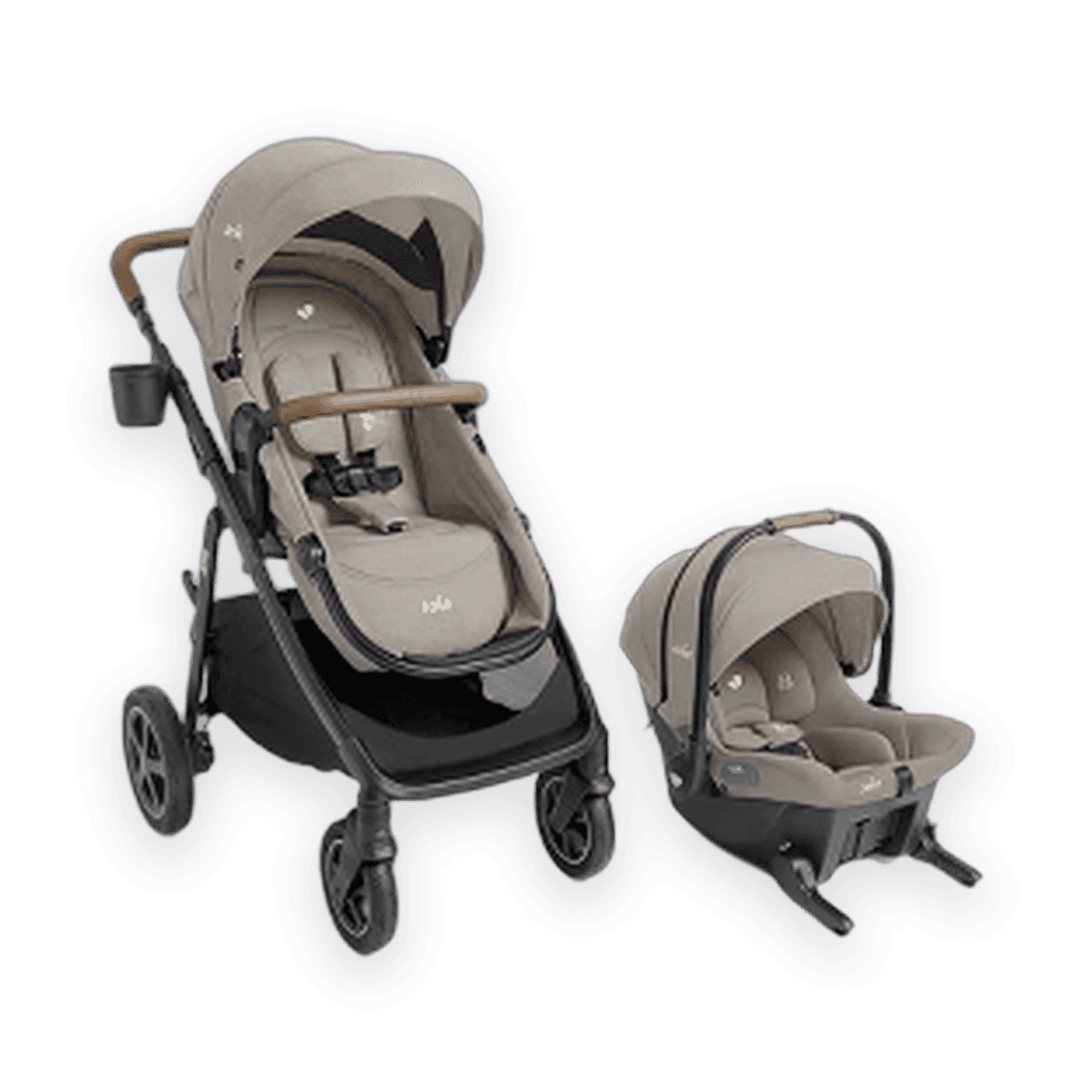
Product image via Target
Where to buy
Prices checked Sep 22, 2026- TargetCheck price at Target
- Brand siteCheck price at Brand site
We may earn a commission from links on this page, at no extra cost to you. How this works.
19 min read · Reviewed by Huggle Hive Editorial Team, Parent-led product research team · Updated August 3, 2026
The Joie Ginger DLX and Mint LATCH Travel System is a full size, buy it once setup for the first years of pushing: a stroller frame rated to a 50 pound child, the Mint infant car seat, and a LATCH base for the car. It suits parents starting from zero who want the newborn stage and the preschool stage covered by the same purchase, and who do most of their walking on sidewalks, store floors, and parking lots. The trade off is straightforward: 26.67 pounds to lift, on plastic wheels built for smooth ground.
Our scorecard
How the Hive Score works- Portability
- 4.0
- Safety basics
- 3.9
- Comfort & ride
- 4.3
- Versatility
- 2.9
- Value
- 3.0
Scores blend each product's verified specs with its overall owner rating, weighted the same way for every stroller. Learn more about our evaluation framework.
The short version
- Rated for 0 to 5 years with a 50 pound seat limit, so it can stay in rotation long past the toddler stage
- Ships as a travel system: stroller, Mint infant seat, and LATCH base in one box
- 26.67 pounds is the number to plan around if you load a trunk or climb stairs every day
- Plastic wheels mean nothing to inflate and nothing to puncture, but they favor pavement over parks
- Folds to 32 by 24.5 by 21 inches, roughly 9.5 cubic feet of trunk space
- Warranty is listed at one year, short next to the five year age stage
Pros
- 50 pound seat limit outlasts plenty of strollers that tap out earlier
- 0 to 5 year age stage covers the infant seat phase and the preschool years in one purchase
- Infant seat and LATCH base included, so the newborn car setup is sorted in the same box
- 24.5 inch open width clears a standard interior doorway with room on both sides
- Metal in the frame rather than an all plastic build
- Plastic wheels never go flat and need no air, no tubes, no maintenance
Cons
- 26.67 pounds is a real lift for a stroller you fold and load daily
- Plastic wheels give up ride quality on brick, gravel, and cracked sidewalk
- One year warranty is short for gear meant to last five years
- The published specs leave out harness points, recline, and basket capacity, so some of the buying decision rests on the box rather than the spec sheet
- 44.5 inch overall open height means the handle sits low for taller parents
Who it is for, and who should skip it
Buy it if you are starting from nothing. The single strongest argument for this system is arithmetic: one purchase covers the infant car seat, the base that lives in your car, and a stroller seat rated to 50 pounds. Most children do not cross 50 pounds until well past their fifth birthday, which lines up with the 0 to 5 year age stage. That is a long runway for one line item on a registry.
It fits the pavement parent. Sidewalks, the pediatrician's parking lot, the grocery store, the mall in February. Plastic wheels are perfectly happy on all of that, and they will never strand you with a flat.
Think harder if you live at the top of a walk up. At 26.67 pounds, this is a stroller you park at ground level and roll, not one you carry up two flights with a diaper bag on your shoulder. Same caution if your weekends happen on trail gravel, wood chips, or grass: plastic wheels and a frame with no documented suspension are not the tool for that job. If you are tall enough that a low handle bothers you, note that the entire open frame tops out at 44.5 inches, so the push bar sits at or below that height. And if you already own an infant seat you like, a bundled travel system means paying for a seat and base you do not need.
How it performs
Fold, weight, and the trunk test
Folded, it measures 32 inches tall by 24.5 wide by 21 deep. Multiply that out and you get about 9.5 cubic feet of space. A mid size sedan trunk commonly falls in the 13 to 16 cubic foot range, so the stroller takes most of it and leaves you a corner, not a second shelf. Groceries and a stroller in the same trunk is a planning exercise, not a given.
One detail worth catching: the folded width and the open width are identical at 24.5 inches. The wheels do not tuck inward when it folds. The fold shrinks the height and the length, and that is where all the savings come from.
Then there is the 26.67 pounds. That is the frame and seat, before you add anything you hang off it. Lifting that into a trunk once is nothing. Doing it four times a day, at the end of a nap fight, is the part parents actually feel.
Wheels and ride quality
The wheels are plastic, and that cuts both ways honestly. On the plus side: no tubes, no pump, no punctures, no slow leak you discover in a parking garage. Plastic wheels are the low maintenance choice, and they keep weight and cost down.
On the minus side, plastic transmits more of the ground to the seat than rubber or foam does. Expansion joints, brick crosswalks, and the cracked stretch of sidewalk on your block will register. Nothing in the published specifications documents a suspension system, so we cannot credit one. Plan around smooth surfaces and this is a non issue. Plan around a gravel park path and it is the first thing you will want to change.
The seat, and how long it lasts
The 50 pound limit is the spec that earns this stroller its keep. Plenty of strollers stop short of that, which is how families end up buying a second one at age three. Paired with the 0 to 5 year age stage, the seat is sized to keep carrying a child who can walk perfectly well and simply will not, which is exactly the child you need a stroller for.
The open footprint backs that up: 35.6 inches front to back and 44.5 inches tall. That is a long, full size chassis, the shape you get when a frame has to stay stable under a 50 pound passenger rather than a 30 pound one. Wide track helps here too. At 24.5 inches across, the stance is broad enough to resist the tip you get when a toddler lunges sideways after a dog.
The 50 pound ceiling and the 0 to 5 year stage are the two numbers that decide whether this is one purchase or the first of two.
Materials and build
The build list is plastic, metal, and polyester. Metal in the frame matters more than it sounds: a frame with metal structure flexes less under load than an all plastic one, which is part of why a 50 pound rating is credible here. Polyester is the standard seat and canopy fabric across the category, easy to wipe and quick to dry.
What is not published: fabric weight, canopy UPF, or whether the seat pad comes off for the washing machine. Those are the questions to ask before you buy, not things we will guess at.
Safety basics: what the specs confirm, and what they do not
Every stroller sold in the United States has to meet the federal standard for carriages and strollers, 16 CFR 1227, which incorporates the ASTM F833 requirements covering things like stability, restraint systems, and brakes. You can read the underlying rulemaking at the Consumer Product Safety Commission. That is the floor, and it applies here.
Above that floor sits voluntary certification. JPMA's certification program puts products through third party testing to the same voluntary standards, and it is not documented in the specifications we have for this system. Treat that as unconfirmed rather than absent, and check the carton or ask Joie directly if certification is a dealbreaker for you.
The car side comes with a LATCH base, meaning the Mint seat installs to your vehicle's lower anchors rather than the seat belt. Two things to verify in your own car: where your lower anchors actually are (your vehicle manual has a diagram), and the combined child plus seat weight at which your vehicle requires you to switch from LATCH to the seat belt. The American Academy of Pediatrics car seat guidance is the reference we would send a first time parent to on that question.
Fit and sizing: from the hospital ride home to age five
| Spec | Number | Why you care |
|---|---|---|
| Age stage | 0 to 5 years | Covers newborn through preschool with one frame |
| Max child weight | 50 lb | Outlasts strollers that stop earlier |
| Stroller weight | 26.67 lb | The daily lift into the trunk |
| Open (H x W x D) | 44.5 x 24.5 x 35.6 in | Clears standard doorways, long footprint in a cafe |
| Folded (H x W x D) | 32 x 24.5 x 21 in | About 9.5 cubic feet of trunk |
| Wheels | Plastic | Zero maintenance, pavement preferred |
| Materials | Plastic, metal, polyester | Metal frame under a polyester seat |
| Warranty | 1 year | Short relative to the five year stage |
The practical sizing news is good on width. Standard interior doorways in US homes run about 28 to 32 inches, so a 24.5 inch open width gets through your front door, the pediatrician's exam room door, and most restroom doors without the shuffle and angle routine. Store aisles are the same story.
Depth is where you will need to pay attention. At 35.6 inches open, this occupies close to three feet of floor front to back. In a narrow coffee shop or a packed elevator, that is the dimension that makes you the person everyone steps around.
Height is the one to measure against yourself. The whole frame stands 44.5 inches at its tallest point, which puts the handle at or below roughly waist to lower rib height on an average adult. Parents around six feet and up should try the push position before committing, because a low bar means either bent wrists or a slight stoop over a long walk.
What it costs to own
Price is only the first number. The one that tells you whether a stroller was worth it is cost per month of actual use, and this system is built to make that math flattering. Take whatever you pay and divide it by 60 months, the span implied by the 0 to 5 year age stage. A stroller you replace at age two and a half has to be divided by 30 instead, which doubles the effective cost of the same sticker price. The 50 pound seat limit is what keeps the denominator big.
The bundle helps too. You are buying three things at once: the stroller, the Mint infant seat, and the LATCH base. Priced separately, those are three separate decisions and three separate shipments, and the base alone is a purchase most parents forget to budget for until the hospital discharge conversation.
What you are paying for, in one list:
- A frame rated to carry a 50 pound child, not a 35 pound one
- An infant car seat and LATCH base included rather than bought later
- Plastic wheels with no ongoing consumables, no tubes, no pump, nothing to replace
- A polyester and metal build in the middle of the category, not a premium modular system
- One year of warranty coverage, which is where the value case gives ground
That warranty term is the honest weak spot in the ownership math. Twelve months of coverage against a five year use case means years two through five are on you. It is not unusual at this end of the market, and it is worth registering the product and filing your receipt on day one so the first year is actually usable.
There is also the second stroller question, which nobody puts on a price tag. If you fly, or if you spend weekends on unpaved ground, a 26.67 pound frame on plastic wheels is not the thing you will want to gate check or push across a field. Many families end up with a cheap umbrella stroller alongside a system like this one. Budget for the possibility rather than being surprised by it.
Where does that leave the value picture? Middling to good, and dependent on how you shop. Judged on longevity per dollar, the 50 pound ceiling and the five year stage are genuinely strong. Judged on what is included, a bundled seat and base beat piecing it together. Judged on materials and coverage, plastic wheels and a single warranty year are what you accept in exchange. That balance is what our Value sub-score of 3.8 out of 5 reflects.
How it compares to the other ways to buy a stroller
We do not have a like for like peer set with confirmed specs to put beside this one, so rather than guess at competitor numbers, here is the comparison that actually shapes the decision: this system against the three other shapes a first stroller can take.
Against a lightweight or umbrella stroller. Those typically live in the mid teens on weight and fold small enough for an overhead bin or a back seat footwell. They win the daily lift and lose almost everything else: most start later than newborn, many cap out well below 50 pounds, and none of them come with an infant seat and LATCH base. If your life is stairs, transit, and travel, that category is the better first buy, and you accept a shorter useful life.
Against an all terrain or jogging stroller. Air filled tires and real suspension are what you are paying for there, and they transform how a stroller handles gravel, grass, and broken pavement. They also add weight, add width, and add maintenance: tubes go flat, and you will own a pump. The Ginger DLX's plastic wheels are the opposite bargain, less capable off pavement and completely maintenance free on it.
Against a modular premium system. The high end sells configurability: reversible seats, bassinet attachments, second seat kits, multi position recline. Those features are not documented in the specs we have here, and a Versatility sub-score of 2.4 out of 5 is the direct consequence of that thin documentation. If you know you want a bassinet or a future sibling seat, shop that category with your eyes open and expect to pay considerably more for the privilege.
If you want the wider field, our stroller reviews and the best travel systems guide put the shapes side by side.
What the spec sheet leaves out
A fair review says what it does not know. Four gaps here would move a purchase decision, and all four are worth a two minute check on the product page or the carton before you order.
| Not published | Why it changes your decision |
|---|---|
| Harness points | A 5 point harness contains a determined toddler in a way a 3 point one does not |
| Recline positions | Whether the seat drops far enough for a real nap, and whether it does so one handed |
| Storage basket capacity | The difference between a diaper bag fitting underneath and riding on the handle |
| Infant seat weight and height limits | Determines exactly when you graduate out of the Mint seat and into the stroller seat |
None of these gaps are evidence of a shortcoming. They are simply not in the verified data, and we will not fill them in with a guess.
How we scored it
Our five sub-scores are computed from the verified specifications, each on its own 0 to 5 scale. The headline Hive Score of 8.5 out of 10 is a weighted summary rather than a straight average of those five, so read them together: the Hive Score is the verdict, and the sub-scores show you where the stroller earns its keep and where it gives ground.
Comfort and ride, 4.3. The highest number on the card, and it rests on the build rather than the brochure. Metal in the frame, not an all plastic chassis, is what keeps a seat rated to 50 pounds from flexing under a real child. The 24.5 inch track is wide enough to stay planted when a toddler throws their weight sideways, and the 35.6 inch open footprint is the long wheelbase of a full size stroller rather than the short, twitchy one of a compact. Polyester seating is the category standard. What holds this back from higher: plastic wheels transmit more road than rubber, and no suspension or multi position recline is documented.
Portability, 4.0. Strong on shape, average on mass. Folded, 32 by 24.5 by 21 inches is a manageable rectangle at roughly 9.5 cubic feet, and 26.67 pounds sits below the heaviest full size systems. Nothing in the specs confirms a one hand fold or a self standing fold, so neither earns credit here.
Safety basics, 3.9. This dimension starts below the others deliberately, because safety credit is earned through documentation rather than assumed. Harness point count, JPMA certification, and GREENGUARD Gold are all absent from the published specifications, so none of them lift the number. Read that as a thin spec sheet, not as a red flag, and verify on the carton.
Value, 3.8. The 0 to 5 year stage and 50 pound ceiling stretch the cost across a long runway, and the included infant seat and LATCH base fold three purchases into one. Plastic wheels and a single year of warranty coverage are what pull it back to the middle.
Versatility, 2.4. The weakest line, and the most fixable one. This dimension builds up from a low base and only rises when configuration features are documented. Being a bundled travel system counts in its favor. Reversible seat, bassinet compatibility, a second seat position, and recline type are not in the data we have, so the score stays near the floor. Our full review methodology explains how each dimension is built.
Is the Joie Ginger DLX and Mint LATCH Travel System suitable for a newborn?
It ships as a travel system with the Mint infant car seat and a LATCH base, and the age stage starts at 0 years, so a newborn rides in the infant seat clicked onto the frame. The stroller seat's recline positions are not listed in the published specifications, so if you want to know exactly when your baby can ride in the stroller seat itself, check the manual before you buy.
How much does it weigh, and is that a lot?
The stroller weighs 26.67 pounds, which covers the frame and seat and does not include the infant car seat. For context on where that sits: lightweight and umbrella strollers commonly land in the mid teens, while full size travel system frames commonly run from the high 20s into the low 30s. This one is squarely in full size territory, so plan on rolling it rather than carrying it.
How long will my child fit in it?
The seat is rated to 50 pounds and the age stage runs 0 to 5 years. Most children do not reach 50 pounds until after their fifth birthday, so the weight limit is unlikely to be what ends your use of it. That longevity is the core of the value argument.
Will it fit in my car?
Folded it measures 32 inches tall by 24.5 wide by 21 deep, roughly 9.5 cubic feet. A mid size sedan trunk is commonly 13 to 16 cubic feet, so it fits with space left over but not a lot of it. Measure your trunk opening as well as the trunk itself, since a narrow opening is what usually defeats a 32 inch fold.
Can I use it on grass, gravel, or trails?
The wheels are plastic and no suspension is documented, so this is a pavement stroller. Sidewalks, store floors, parking lots, and airport terminals are its element. For regular park paths, gravel, or grass, an all terrain frame with air filled tires is the right tool, and you accept the added weight and tire maintenance that comes with it.
Is it JPMA certified?
JPMA certification is not documented in the specifications we have, which means unconfirmed rather than absent. Every stroller sold in the United States must meet the federal standard for carriages and strollers, 16 CFR 1227, which incorporates ASTM F833. If third party certification matters to you, check the carton or ask Joie directly.
What does the warranty cover?
The published warranty term is one year. What that year specifically covers is not in the specifications we have, so read Joie's warranty terms before purchase. Whatever the coverage, register the product and keep your receipt on day one, because twelve months goes quickly against a five year age stage.
Will I still need a second stroller?
Possibly, and it is worth budgeting for. At 26.67 pounds on plastic wheels, this is not the stroller you want to gate check for a flight or push across a field. Plenty of families keep an inexpensive umbrella stroller alongside a full size system for travel and quick errands.
Where to buy
Stock and pricing on travel systems move around, particularly on color combinations, so compare across retailers before you commit and check the current listing for anything the spec sheet leaves open, like harness points and basket capacity.
You can also confirm current specifications and warranty terms on Joie's official site before ordering.
Bottom line
The Joie Ginger DLX and Mint LATCH Travel System is the practical pick for a first time parent who wants the newborn car setup and the preschool stroller settled in one purchase. A 50 pound seat limit and a 0 to 5 year stage give it a long runway, the metal frame and wide stance suit a full size ride, and the included Mint seat and LATCH base remove two more decisions from a stressful month. Accept the trade offs before you buy: 26.67 pounds is a genuine daily lift, plastic wheels want pavement, and one year of warranty is thin against five years of use. If your walking happens on sidewalks and your stroller lives in a trunk rather than up a staircase, that is a fair bargain.
Joie Ginger DLX and Mint LATCH Travel System
See prices