
Evenflo Shyft DualRide Travel System
Price verified Sep 11, 2026
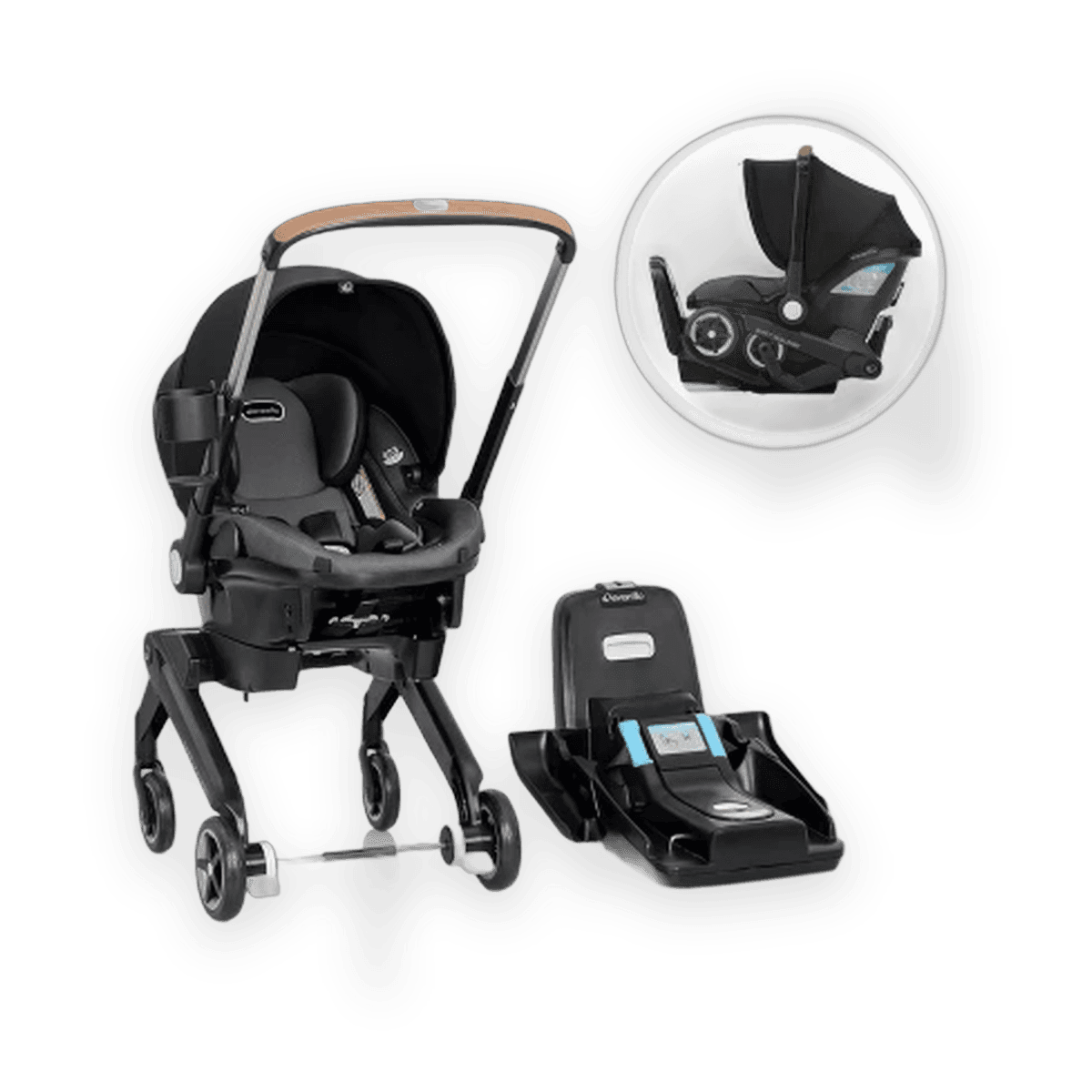
Product image via Target
Where to buy
Prices checked Sep 11, 2026- TargetCheck price at Target
We may earn a commission from links on this page, at no extra cost to you. How this works.
19 min read · Reviewed by Huggle Hive Editorial Team, Parent-led product research team · Updated August 2, 2026
The short answer
The Shyft DualRide is one piece of gear doing the job of two, and for the first eighteen months it mostly pulls that off. Lift the carrier off the base, release the wheels, and the infant car seat is the stroller. There is no frame to unfold, nothing to click into place, nothing extra eating your trunk. What you pay for that is weight and runway: Evenflo lists it at 29 pounds before your baby is in it, and the whole system retires when your child reaches 30 pounds or 32 inches. Overall rating: 7.9 out of 10.
Evenflo Shyft DualRide at a glance
- Shyfts from infant car seat to stroller in one step: lift the carrier off the base, release the wheels, roll.
- Designed for infants 3 to 30 pounds and 15.7 to 32 inches, with a no-rethread harness that adjusts to 8 positions.
- JPMA certified and meets FMVSS 213, the federal safety standard for child restraints.
- Listed at 29 pounds, so stairs and curbs are a genuine lift once your baby is aboard.
- Full-coverage canopy with UPF 50+; Evenflo says it also blocks rain and snow.
- Overall rating of 7.9 out of 10, with Comfort and ride the strongest sub-score and Versatility the weakest.
Pros
- One-step change from car seat to stroller, with no separate stroller frame to carry, unfold or store
- Wide growth window for an infant seat: 3 to 30 pounds and 15.7 to 32 inches
- 8-position no-rethread harness, so you raise the straps as your baby grows without pulling the seat apart
- JPMA certified and meets FMVSS 213
- UPF 50+ full-coverage canopy that Evenflo says blocks rain and snow as well as sun
- Adjustable handlebar plus a cup holder and tray
- Evenflo places the carrier higher on the wheels, so your baby rides closer to you
- Evenflo says the padding is washable, which matters more than usual on a car seat with wheels
Cons
- 29 pounds listed, before your baby's weight, so carrying it up a flight of stairs is real work
- Folded footprint of 26 x 18 x 21.88 inches takes a serious bite out of a sedan trunk
- The same wheels that roll through parking lots ride back into your car with the carrier
- Evenflo names Carryall Storage in the product title but does not publish its capacity in the information we have, so a packed diaper bag may or may not fit
- Short runway: at 30 pounds or 32 inches you are shopping for both a stroller and a convertible car seat
- Evenflo lists integrated SensorSafe technology but does not spell out what it monitors in the product information we have
Who is the Shyft DualRide for?
If your days are built out of short hops, this format earns its keep. Drive to daycare, park, lift, roll in. Drive to the pediatrician, park, lift, roll in. A conventional travel system asks you to haul a stroller frame out of the trunk and snap the seat into it every single time; the DualRide asks you to release the wheels. Over a year of errands with a baby who wakes when you look at them sideways, that difference is the whole pitch.
It also suits parents who are short on storage. One item lives in the car instead of two, and at 26 inches tall by 18 wide by 21.88 deep folded, it goes in a trunk or a hall closet as a single object rather than a frame plus a carrier.
Think hard if you live up stairs. Evenflo designed for that case (retract the wheels, carry up or down, pop them back down) but the arithmetic is unforgiving. Add a 15 pound four-month-old to a 29 pound system and you are lifting roughly 44 pounds one-handed on a stairwell. That is fine for some parents and a daily ordeal for others, and only you know which one you are.
Skip it if you want gear that grows with your family. The DualRide covers 0 to 18 months and stops. Parents who would rather buy one stroller that converts to a toddler seat, takes a second child later, or handles trail-grade terrain should put their money into a full-size stroller and a separate infant seat, and read our best travel systems guide before they commit.
Performance
The one-step change is the whole product
Everything the DualRide is good at flows from a single design decision: the wheels live on the car seat. Evenflo's description of the sequence is plain enough. Moving from car to sidewalk, you lift the carrier off the base and release the wheels. Facing stairs, you retract the wheels, carry, then put them back down.
That removes the two moments parents actually dread. You are not wrestling a folded frame out of a trunk in the rain with one hand on the carrier, and you are not doing the snap-in, snap-out ritual that wakes a sleeping newborn about half the time. The system is travel-system compatible in the sense that matters most: the seat and the base talk to each other, and the wheels come along for free.
One piece of gear, one motion. If your life is a string of ten-minute stops, that is worth more than a spec sheet full of features you use twice a month.
The honest limit of the format is that a car seat is a car seat. It is sized and shaped to protect an infant in a crash, not to be a stroller seat, which is why the growth window closes at 30 pounds instead of the 45 to 55 pounds a full-size stroller seat typically covers.
Safety basics and getting the install right
The certification picture is solid. The DualRide is JPMA certified and meets FMVSS 213, the federal motor vehicle safety standard every child restraint sold in the United States has to satisfy. FMVSS 213 is a floor rather than a distinction, so read it as table stakes; JPMA certification is a third-party program on top of that.
Evenflo describes LockStrong as a belt-tensioning system and pairs it with Quick Connectors, and says together they deliver a solid, secure installation quickly. Take that as the manufacturer's claim, then verify it in your own car, because belt tension is where installs actually go wrong. A base that slides is the most common error technicians see. NHTSA's car seat guidance is the reference to use: grip the base at the belt path and confirm it does not move more than an inch side to side or front to back, and find a certified technician if anything feels off.
Evenflo also lists integrated SensorSafe technology and describes it as adding a layer of protection. The product information we have does not say what the system monitors or how it alerts you, so we are not going to characterize it further. If SensorSafe is part of why you are buying, read the manual or ask Evenflo directly before you count on a specific behavior.
One piece of guidance that applies to every car-seat-on-wheels product, this one included: the American Academy of Pediatrics advises against using a car seat for routine sleep outside the vehicle. A format this convenient makes it easy to let a nap run long in the carrier. Move your baby to a flat, firm surface once you are home.
Weight, stairs and the 29 pound question
Twenty-nine pounds is the number to sit with. It is heavier than most standalone infant carriers because the wheels, the frame and the storage are all part of the same object, and you are never separating them. In the car park that is irrelevant, since the wheels do the work. On a stoop, a subway staircase or the three steps up to your front door, it is the defining fact of ownership.
Worth being clear about what the spec does and does not tell us: 29 pounds is the listed weight and the open dimensions are 41.5 inches tall by 18 wide by 29.5 deep. Everything else about handling is a matter of your build, your stairs and your baby's size.
| Spec | Figure |
|---|---|
| Listed weight | 29 lb |
| Open (H x W x D) | 41.5 x 18 x 29.5 in |
| Folded (H x W x D) | 26 x 18 x 21.88 in |
| Child range | 3 to 30 lb, 15.7 to 32 in |
| Harness | No-rethread, 8 positions |
| Canopy | Full coverage, UPF 50+ |
| Materials | Polyester, metal, plastic |
| Certifications | JPMA certified, meets FMVSS 213 |
At 18 inches wide it clears standard doorways and most shop aisles, which is the width number that matters day to day. The 21.88 inch folded depth is the one to measure against your trunk before you buy, especially in a sedan. It will not disappear back there.
Sun, rain and the canopy
UPF 50+ is a real number, not marketing vapor, and it is the highest rating fabric gets. On a canopy Evenflo describes as full coverage, that means you can park a newborn on a sunny sidewalk without a muslin blanket draped over the seat, which is the improvised solution that traps heat. Evenflo also says the canopy blocks rain and snow. That is their claim, and it is the kind of claim a full-coverage design supports, but treat a heavy downpour as a dash for the car rather than a stroll.
Comfort, the handlebar and where your baby rides
Comfort and ride is the strongest sub-score here at 4.2, and two confirmed features carry it. The handlebar adjusts, so parents of noticeably different heights can share the same walk without one of them hunching. And Evenflo sets the carrier higher on the wheels than a typical travel system does, which puts your baby closer to your face. For a newborn who settles on eye contact, that height is a practical feature, not a styling choice.
There is a cup holder and tray on board, which sounds trivial until you are holding a coffee at a crosswalk.
The wheels come back into your car
This is the question every parent asks about this format, and it deserves a straight answer. The wheels roll across parking lots, sidewalks, salted winter pavement and whatever the grocery store floor has on it. Then they retract and the whole carrier goes back into your vehicle and clicks onto the base. There is no separating the dirty part from the clean part, because they are the same part.
Plan for it rather than be surprised by it. A rag in the door pocket and a quick wipe of the wheels before the carrier goes in handles most of it. Evenflo says the padding is washable, which is the single most useful spec on the sheet for a product like this: the seat your baby sits in will meet more outdoor grime than a conventional carrier does, and being able to strip and wash the fabric is what keeps that manageable over eighteen months.
If a spotless back seat is non-negotiable for you, that is a legitimate reason to choose a conventional travel system instead, where the wheels stay in the trunk.
Where the diaper bag goes
The full product name is the Shyft DualRide Infant Car Seat Stroller Combo with Carryall Storage, so storage is part of the design, and a cup holder and tray are confirmed. What Evenflo does not publish in the information we have is how much the Carryall Storage actually holds. That gap matters, because a conventional travel system gives you a large under-seat basket and most parents plan around it.
Our advice: assume you will wear the diaper bag rather than stow it, and treat any capacity beyond that as a bonus you confirm in person.
How long will it fit my baby?
The DualRide is designed for infants from 3 to 30 pounds and 15.7 to 32 inches, and Evenflo lists the age stage as 0 to 18 months. Both limits count, and in practice the height limit usually arrives first. Babies run out of shell before they run out of pounds.
| Stage | What to expect |
|---|---|
| 3 lb and up | Bottom of the range covers small and preemie newborns, so most families can use it from day one |
| Newborn to about 6 months | The stage the format is built for: constant short trips, a baby who should not be woken |
| 6 to 18 months | Keep watching height. Once your child hits 32 inches or 30 lb, the seat is done regardless of the calendar |
The harness is the other half of fit. It is a no-rethread design with 8 positions, which means you raise the shoulder straps as your baby grows by adjusting a headrest rather than uninstalling the seat and threading webbing through a different slot. Rear-facing, the straps should sit at or just below your baby's shoulders, and you will move them up several times over eighteen months. Eight positions is a generous count, and no-rethread is the feature that makes you actually do the adjustment instead of putting it off.
When the DualRide retires, you need two replacements at once: a convertible car seat and a stroller. Budget for that before it lands on you.
What it costs to use
Pricing on travel systems moves with retailer and season, so rather than print a number that ages badly, check the current price through the retailer links below before you commit. What we can lay out is the shape of the spend, which is what actually decides whether this format is a bargain or not.
What you are paying for:
- An infant car seat with a 3 to 30 pound range, a 3-position base install and an 8-position no-rethread harness
- The stroller for that same period, integrated rather than bought separately
- A UPF 50+ full-coverage canopy, an adjustable handlebar, a cup holder and tray
- JPMA certification and FMVSS 213 compliance
- One item in the trunk instead of two
What it does not buy you: anything past 30 pounds or 32 inches. A conventional travel system leaves you with a stroller frame you keep using for years after the infant seat is retired. This one goes away as a unit. So the fair comparison is not just sticker price against sticker price, it is DualRide price against the price of an infant seat plus a stroller you will still own when your child is three.
Run that math both ways with real numbers from your own shortlist. If the DualRide lands near the cost of a mid-range infant seat on its own, the built-in stroller is close to free and the format wins. If it lands near the cost of an infant seat plus a stroller with a long life, the shorter runway is a genuine cost.
How it compares to other travel system formats
No product in our stroller set works quite like this one, so the useful comparison is format against format.
Against a conventional travel system. The standard setup pairs an infant seat with a full stroller frame that keeps working long after the seat is outgrown, usually to 45 pounds or more, and gives you a proper under-seat basket. You pay for it in trunk space and in the snap-in ritual at every stop. Choose the conventional route if you want years out of the stroller half and if the wheels-into-the-car issue bothers you.
Against a car seat frame stroller (the snap-and-go type). A frame is lighter and cheaper than the DualRide and does a similar job, but it is a second object: it lives in your trunk, you unfold it, you lift the carrier onto it. That is more steps and more weight in total, but each individual lift is lighter than 29 pounds. Parents with stairs and no elevator should look hard at this option.
Against a full-size stroller plus a separate infant seat. This is the most gear, the most money and the most capability. Suspension, big wheels, a toddler seat, sometimes a second seat later. If you walk long distances daily, hit rough ground, or plan on a second child inside three years, that combination beats the DualRide on everything except the one motion the DualRide exists for.
Browse our full stroller reviews to price each of those routes against your shortlist.
How we scored it
Comfort and ride, 4.2. The highest sub-score, and it comes from confirmed features rather than atmosphere. The canopy is rated UPF 50+ and Evenflo describes it as full coverage, the handlebar adjusts for parents of different heights, and the carrier sits high on the wheels so your baby rides near you.
Safety basics, 3.9. JPMA certification and FMVSS 213 compliance both land here, alongside the 8-position no-rethread harness that makes correct strap height easy to maintain. This dimension is deliberately anchored a little below the overall rating, because safety credit comes from documented certification rather than from marketing language.
Portability, 3.7. The listed 29 pounds is what holds this back. Folded, it is reasonably contained at 26 inches tall by 18 wide by 21.88 deep, and 18 inches of width is genuinely narrow. But portability for a car-seat-stroller hybrid means the lift, and 29 pounds plus a baby is a heavier lift than most infant carriers ask for.
Versatility, 2.9. The weakest number, and it is a design consequence rather than a flaw. The DualRide does one job across 0 to 18 months and then stops. It is travel-system compatible by definition (the seat and base are one system), but the seat is the car seat, so there is no second life as a toddler stroller.
Value, 3.6. Middle of the pack. You are buying one thing that covers the infant car seat and the stroller for the whole newborn stretch, which is real savings in money and trunk space. Set against that, the 30 pound and 32 inch ceiling means you will be shopping again inside two years.
All five roll up to an overall rating of 7.9 out of 10. Our review methodology explains how the dimensions are set.
Price and value
The value case rests on how you count. As an infant car seat alone, this is a well-certified seat with a wide 3 to 30 pound range and a no-rethread harness. The wheels are the extra you are paying for, and whether they are worth it depends almost entirely on how many times a week you move a sleeping baby from a car to a sidewalk. Four times a day, the DualRide is a bargain. Twice a week, buy the stroller with the longer life.
Is the Evenflo Shyft DualRide safe for a newborn?
It is designed for infants from 3 pounds and 15.7 inches, so it covers newborns including small and preemie babies. It is JPMA certified and meets FMVSS 213, the federal standard for child restraints. As with any infant seat, the safety comes down to installation: confirm the base does not move more than an inch at the belt path, and keep the harness straps at or just below your baby's shoulders when rear-facing.
How long will my baby fit in it?
Until 30 pounds or 32 inches, whichever comes first. Evenflo lists the age stage as 0 to 18 months. Height is usually the limit that arrives first, so measure rather than count birthdays. When your child outgrows it you will need a convertible car seat and a stroller, since the whole system retires together.
Can I take it on a plane?
FAA approval is not part of the verified specs we have for this seat. Every restraint certified for aircraft carries a label on the seat saying so, so check the label and Evenflo's manual before you fly. Two format-specific notes: the unit is listed at 29 pounds, and the wheels are built into the carrier, so it is bulky to move through a terminal. If you plan to gate-check it, ask your airline how they handle a wheeled car seat first. The FAA's guidance on <a href="https://www.faa.gov/travelers/fly_children/child_safety_seats">child safety seats on aircraft</a> is worth reading before you book.
Do the stroller wheels get my car dirty?
They can, and it is the honest trade-off of this format. The wheels retract but they stay attached to the carrier, so whatever they rolled through comes back into the vehicle. Keep a rag in the door pocket and wipe them before the carrier goes on the base. Evenflo says the padding is washable, which helps for the seat itself.
Where does the diaper bag go?
The product name includes Carryall Storage and a cup holder and tray are confirmed, but Evenflo does not publish the storage capacity in the information we have. Plan on wearing the diaper bag and treat anything the storage swallows as a bonus. Do not hang a heavy bag from the handlebar.
Will it fit in my trunk?
Folded it is 26 inches tall by 18 wide by 21.88 deep. That fits a typical sedan trunk, but it is a substantial object and it will not tuck away out of sight. Measure your trunk opening against that 21.88 inch depth before you buy.
How is it different from a regular travel system?
A regular travel system is two pieces: an infant seat plus a stroller frame you unfold and snap the seat into. The DualRide is one piece, with the wheels built onto the car seat, so the change from car to sidewalk is a single step. You give up the long-lived stroller half, since this system stops at 30 pounds and 32 inches.
Does it come with a car seat base?
Yes. The design centers on lifting the carrier off the base and rolling away, and Evenflo lists LockStrong belt tensioning and Quick Connectors as part of the installation system. Follow the manual for your specific vehicle, and use a certified technician if you want the install checked.
Where to buy the Evenflo Shyft DualRide
Check current pricing and stock before you decide, since travel system prices move with the season.
See the Shyft DualRide at EvenfloThe bottom line
Buy the Shyft DualRide if your first year is going to be a string of short car trips and you want the fewest possible steps between the driver's seat and the sidewalk. The one-step change is the real thing, the certifications are in order, and the UPF 50+ canopy and adjustable handlebar make the walking half pleasant. Go another way if you have stairs and no elevator, because 29 pounds plus a baby is a daily lift, or if you would rather buy a stroller that is still working when your child is three. Rated 7.9 out of 10.
Evenflo Shyft DualRide Travel System
See prices