
Doona Car Seat & Stroller
Price verified Sep 18, 2026
Product image via Target
Where to buy
Prices checked Sep 18, 2026- TargetCheck price at Target
We may earn a commission from links on this page, at no extra cost to you. How this works.
16 min read · Reviewed by Huggle Hive Editorial Team, Parent-led product research team · Updated August 3, 2026
The Doona Car Seat & Stroller solves one problem completely and refuses to solve any others. If your day is a chain of short car trips, school runs, appointments, a coffee with a friend, it removes the step every travel system makes you repeat: unclipping a seat and clicking it into a frame. Doona lists it at 10 pounds, folding to 23.6 by 17.3 by 26 inches, with rubber wheels and an aluminum and plastic build. What you give up is reach.
Our scorecard
How the Hive Score works- Portability
- 4.5
- Safety basics
- 3.8
- Comfort & ride
- 4.3
- Versatility
- 2.4
- Value
- 3.8
Scores blend each product's verified specs with its overall owner rating, weighted the same way for every stroller. Learn more about our evaluation framework.
The short version
- The wheels retract into the car seat, so there is no stroller frame to attach, carry, or store.
- Doona lists the stroller weight at 10 pounds and a folded size of 23.6 x 17.3 x 26 inches.
- Frame and shell are aluminum and plastic; the wheels are rubber, not hard plastic.
- One seat, one configuration: no reversible seat, no bassinet option, no second-child setup.
- The warranty is 2 years, which is shorter than the run you may get out of an infant car seat.
- Doona lists the age stage as newborn and up; the height and weight limits on the seat label are what actually decide when your baby is done with it.
Pros
- Car seat and stroller are the same object, so there is no frame to click into, lift, or find room for
- Listed at 10 pounds, which is light for something that brings the car seat along with it
- Folds to roughly 6 cubic feet (23.6 x 17.3 x 26 inches), a size most trunks can take alongside a grocery run
- Aluminum and plastic construction keeps the carry weight down where you feel it most, on stairs and curbs
- Rubber wheels grip and run quieter than hard plastic on sidewalks, tile, and hospital corridors
- Rated from newborn, so there is no separate frame or adapter to buy for the first months
Cons
- One seat and one configuration: nothing here grows into a toddler seat, a reversible seat, or a double
- It is an infant car seat, so a convertible seat is a second purchase you should plan for
- The 2 year warranty ends well before a car seat's service life does, so a defect that shows up in year three is your cost, not Doona's
- Doona does not publish a canopy UPF rating or a suspension spec, so sun coverage and ride details have to come from the manual and the label
- Folded width stays at 17.3 inches, the same as open, so it does not flatten the way a lightweight umbrella stroller does
Who is the Doona for, and who should skip it?
Buy it if your baby's life happens in the car. Parents in cities where street parking means walking two blocks, parents doing daily preschool pickup for an older sibling, parents who fly with a baby: those are the situations where saving thirty seconds and one lift, twelve times a day, changes the shape of the day. It is also a strong fit for anyone with a small trunk or a walk-up apartment, because there is no second piece of gear to haul.
Skip it if most of your outings start at your own front door. If you walk to the park, the shops, and the trail, you will be pushing an infant car seat around for hours when a stroller seat that reclines flat and converts to a toddler seat would serve your baby better and serve you for three more years. The same logic applies if a second child is already in the plan, since there is no second-seat option here.
The Doona is not a stroller that happens to hold a car seat. It is a car seat that happens to roll, and every strength and limit on this page follows from that one decision.
If your budget only stretches to one big purchase, think carefully. A convertible car seat plus a full-size stroller costs more up front and is clumsier on day one, but it covers you into the toddler years. The Doona covers the infant stage brilliantly and then retires.
How does it actually perform?
The fold is the entire product
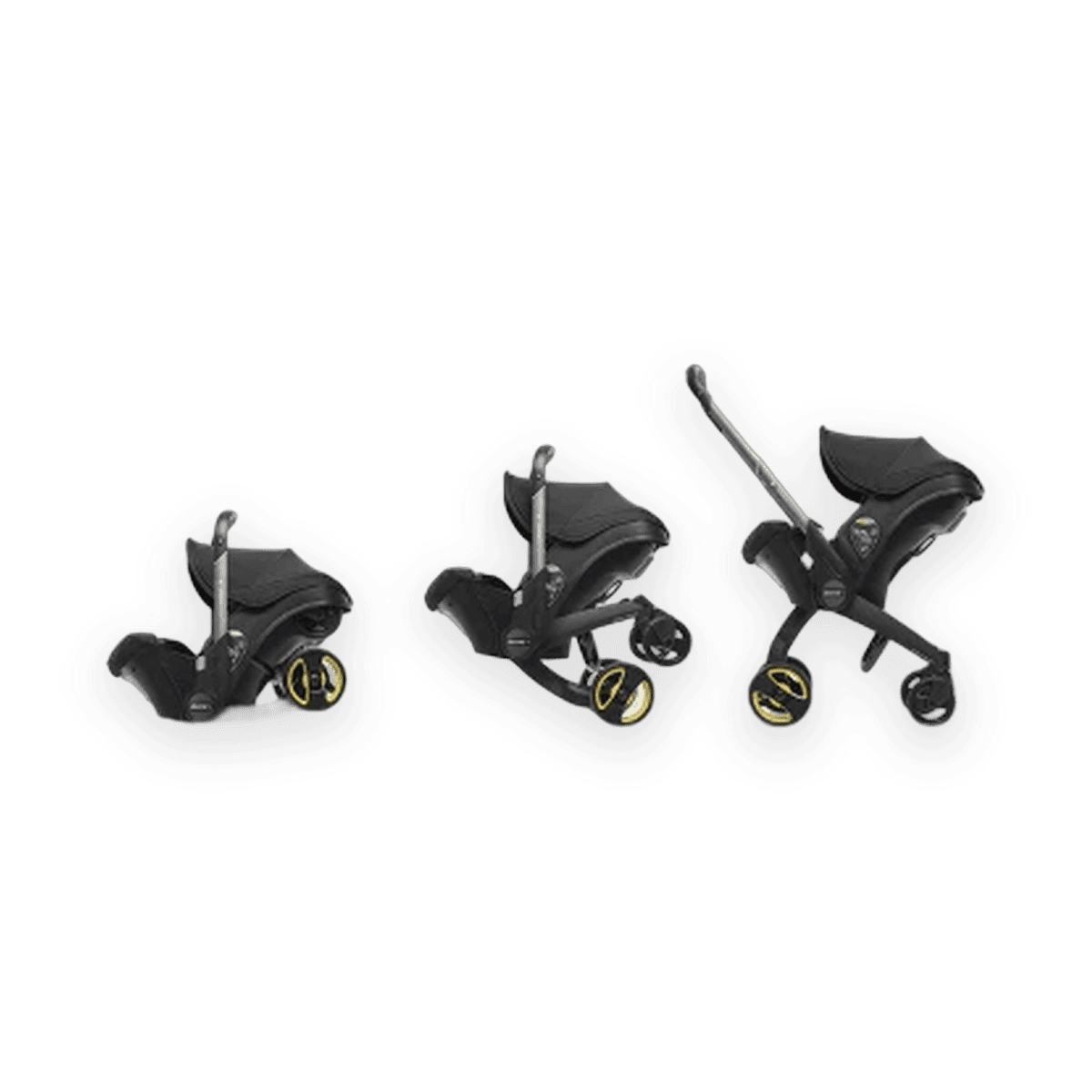
The wheels retract into the shell, which means the transition from car seat to stroller is a single motion with no parts left over. That matters more than it sounds like it should. Every travel system asks you to store a frame somewhere, usually the trunk, and to lift the seat with your baby in it and line up two clips while a stranger's car waits behind you.
The numbers back the design. Open, it stands 39 inches tall and 32.2 inches deep. Folded, it drops to 23.6 inches tall and 26 inches deep, which is a little over 6 cubic feet of trunk space. Notice what does not change: width stays at 17.3 inches in both states, because the car seat shell sets it. That is the honest limit of the fold. It compacts, it does not flatten.
Doona lists the stroller weight at 10 pounds. Confirm that figure on the label or in the manual for your model and region before you build your plan around it, because carry weight is the number you will feel every time you lift it into a trunk or up a flight of stairs, and it is worth knowing exactly.
Ride quality and those rubber wheels
Rubber wheels are a real spec, not a marketing word. Against hard plastic, rubber deforms slightly over cracks and expansion joints, so more of the bump gets absorbed by the tire instead of traveling up into the seat. It is also quieter on tile and pavement, which is not nothing when the ride is the only thing keeping your baby asleep.
What rubber cannot do is replace wheel size or suspension. Doona does not publish a suspension spec, so treat the ride as suited to sidewalks, shop floors, airports, and smooth paths rather than gravel or grass. If your regular route includes a dirt trail, look at an all-terrain stroller instead and keep this as the car seat.
Materials and build
Aluminum and plastic is the right combination for a product whose whole case is that you can carry it. Aluminum gives the structure its stiffness without the mass of steel, and plastic carries the shell and the wheel housings. This is why the listed weight can sit as low as it does while the frame still holds a folding wheel mechanism.
The practical note for parents: aluminum does not rust the way untreated steel does, so a wet stroller left in a trunk is less of a long-term worry. Plastic, on the other hand, is the part that ages, and heat is what ages it. A car parked in summer sun is a hard environment for any car seat.
What Doona publishes on safety, and what you should check
Here is the straight version. The specifications we work from cover materials, dimensions, weight, age stage, and warranty. They do not include a JPMA certification seal, a harness point count, or a Greenguard Gold listing. That is a gap in the published detail, not a claim that the seat fails any of those things, and the difference matters. The place to settle it is the manufacturer's manual and the label on the seat itself, both of which carry the certification statements, the harness details, and the height and weight limits for your model.
Two pieces of category knowledge worth having as you read that label. First, the American Academy of Pediatrics advises keeping children rear-facing as long as the seat allows, and its car safety seat guidance for families is the plainest summary of the rules. Second, JPMA certification is a voluntary program, so its absence from a spec sheet is not a verdict on a product, and its presence is a real signal when a brand publishes it.
One more habit that applies to every infant seat: nothing goes between your baby and the harness that did not come in the box. Aftermarket headrests, strap covers, and seat protectors change how the harness behaves in a crash and are not part of what the seat was certified with.
Where versatility runs out
This is the honest weak spot, and it is a design choice rather than an oversight. There is one seat, and it faces one way. There is no reversible seat, no bassinet mode, no second seat, and no toddler configuration to move into. The car seat is the stroller, so the stroller ends when the car seat does.
A travel system splits those jobs, which is clumsier at the curb and more flexible over three years. The Doona takes the opposite bet: perfect the first year, then hand off.
Will it fit your car, your trunk, and your front door?
Doona lists the age stage as newborn and up. The number that actually governs the fit is on the seat label, since infant seats are outgrown by height or weight, usually height first when a baby's head approaches the top of the shell. Check the label the day it arrives, then check your baby against it every couple of months.
| Measurement | In use | Folded |
|---|---|---|
| Height | 39 in | 23.6 in |
| Width | 17.3 in | 17.3 in |
| Depth | 32.2 in | 26 in |
What those numbers mean in practice:
- Trunk: the folded block is about 6 cubic feet. Measure the narrowest point of your trunk opening, not the floor, because 17.3 inches has to clear the gap before it can sit anywhere.
- Doorways and aisles: 17.3 inches open is narrow for a stroller, which is the payoff for the shell setting the width. Cafe aisles and apartment doors are not the problem here.
- Back seat: the folded depth of 26 inches is the figure to compare against your rear seat when you are working out whether it rides in the cabin on a road trip.
- Stairs: the 39 inch standing height is the awkward part, not the weight. Fold it before you carry it.
What does it cost to own?
The purchase is one item doing two jobs, so the comparison that matters is not the sticker on the box but the arc of the next three years. On day one, the Doona replaces an infant car seat and a stroller frame. That is real money and real closet space you do not spend.
Then the second half of the arc arrives. Because this is an infant seat, a convertible car seat is a purchase you should plan for from the start, not a surprise. Many families also add a lightweight or full-size stroller once the baby is sitting up and the outings get longer, since pushing a toddler around in an infant shell is not the goal. Budget for the Doona as a first-year specialist that you will supplement, and it is a fair deal. Budget for it as your only wheels through age three, and it is not.
The 2 year warranty belongs in this math too. Car seats stay in service until the date on the shell, and that is typically well past two years from purchase, so the last stretch of the seat's usable life carries no coverage. Keep your receipt and your registration.
What you are actually paying for:
- One motion from car to sidewalk, repeated every single outing
- A 10 pound listed weight and a 6 cubic foot fold, with no second piece of gear
- Rubber wheels and an aluminum frame rather than the cheapest possible build
- Newborn readiness with nothing extra to buy for the first stage
How does it compare to the other ways to solve this?
There are three real approaches to the newborn-and-a-car problem, and picking between them is mostly picking which annoyance you would rather live with.
A traditional travel system pairs an infant car seat with a full stroller from the same brand. It costs you a lift and a click at every stop, plus trunk space for the frame, and it gives you a stroller that reclines flat, often reverses to face you, and carries a toddler for years after the infant seat is retired. Choose this if your walks are long, your routes are varied, or you want one stroller purchase to cover the whole run.
An infant seat plus a lightweight frame is the closest rival in spirit. The frame is a skeleton on wheels that the car seat drops into, so it is cheap and light and folds small. You still have two objects instead of one, and the frame becomes useless the moment your baby outgrows the seat. Choose this if you like the Doona's logic but want the lower entry cost and do not mind the click.
A compact stroller with car seat adapters is the flexible option. You buy the stroller you actually want, then adapt it to whatever infant seat you own. It is the most versatile and the least elegant on day one, since it demands the most gear juggling in the newborn months. Choose this if the stroller, not the car seat, is the thing you will use most.
The Doona wins on exactly one axis, and it wins decisively: the number of objects and motions between a car seat and a rolling stroller. If you want to see how the versatile options are built, our stroller reviews and the travel stroller guide lay out what to look for.
How we scored it
The overall Hive Score is 8.4 out of 10, and the five dimensions below say where that standing comes from. Every judgment here traces back to the published specifications.
Portability: 4.5. The strongest dimension, and the one the whole product is built around. A listed 10 pound weight, a folded footprint of 23.6 by 17.3 by 26 inches, and an aluminum frame all point the same way. The half point held back is the fold itself: the 17.3 inch width does not change when it folds, so it packs as a block rather than a flat panel.
Comfort & ride: 4.2. Rubber wheels are the concrete reason this lands high. They handle sidewalk seams and shop-floor thresholds better than hard plastic and stay quieter doing it. Doona does not publish a suspension specification or an adjustable handlebar height, so we score what is documented and leave it there.
Safety basics: 3.8. This reflects what Doona publishes at the spec level, which covers materials, dimensions, and age stage rather than a JPMA seal, a harness point count, or a Greenguard Gold listing. Those details live on the seat label and in the manual, and reading them is the step we would not skip.
Versatility: 2.4. The lowest dimension and the clearest limitation. One seat, fixed forward, with no reversible option, no bassinet mode, and no second-child configuration. Nothing in the published specification extends this product past the infant stage, and the score says so plainly.
Value: 3.8. Solid rather than exceptional. You get two products in one object and a genuinely light, well-built one at that, against a 2 year warranty and a service window that closes when the infant seat is outgrown. Our full review methodology explains how these dimensions are defined.
Is the Doona safe to use with a newborn?
Doona lists the age stage as newborn and up. The seat's own height and weight minimums and maximums are printed on the label and in the manual, and those are the numbers that govern when it fits your baby. The AAP recommends rear-facing for as long as the seat allows, and a certified child passenger safety technician can check your install in your actual car, which is the single best use of thirty minutes before your due date.
How much does the Doona weigh?
The listed stroller weight is 10 pounds, with an aluminum and plastic build. Confirm the figure on the label or manual for your model and region, since carry weight is what you feel on stairs and at the trunk.
Will it fit in my trunk?
Folded, it is 23.6 inches high, 17.3 inches wide, and 26 inches deep, roughly 6 cubic feet. Measure the narrowest point of your trunk opening rather than the floor, because the 17.3 inch width has to clear that gap first.
Can the Doona be my only stroller?
For the infant stage, yes, if your outings are car-based and on smooth ground. It is an infant car seat on wheels, so once your baby outgrows the seat there is no toddler mode to move into, and most families add a stroller at that point.
Does it work for two children or a toddler?
No. There is one seat and one configuration, with no reversible seat, no bassinet option, and no second-seat attachment. For siblings, look at a stroller built for two or one with a published second-seat setup.
What is the warranty?
Two years. That is shorter than the service life stamped on a car seat shell, so register the product for recall notices and keep your receipt somewhere you will find it in year three.
How does it compare to a regular travel system?
A travel system costs you a lift and a click at every stop plus trunk space for the frame, and pays you back with a stroller that lasts into the toddler years. The Doona reverses that trade: nothing to click, nothing extra to store, and nothing that outlives the infant seat.
Where to buy the Doona
Before you order, check the current model listing and the manual on Doona's official site so you are matching the right specification to your car and your baby's measurements.
Bottom line
The Doona Car Seat & Stroller is the best answer available to one specific question: how do I get a newborn from car seat to sidewalk without a second piece of gear? A listed 10 pounds, a 6 cubic foot fold, rubber wheels, and an aluminum frame all serve that question, and they serve it well.
The cost of that focus is everything outside it. One seat, one configuration, a 2 year warranty, and a job that ends when the infant seat is outgrown. If your life runs through your car this year, we would buy it and plan the convertible seat for later. If your best outings start at your front door and stretch for an hour, we would put the money into a stroller that is still working for you in 2029.
Doona Car Seat & Stroller
See prices