
Delta Children Jeep PowerGlyde Stroller
Price verified Sep 23, 2026
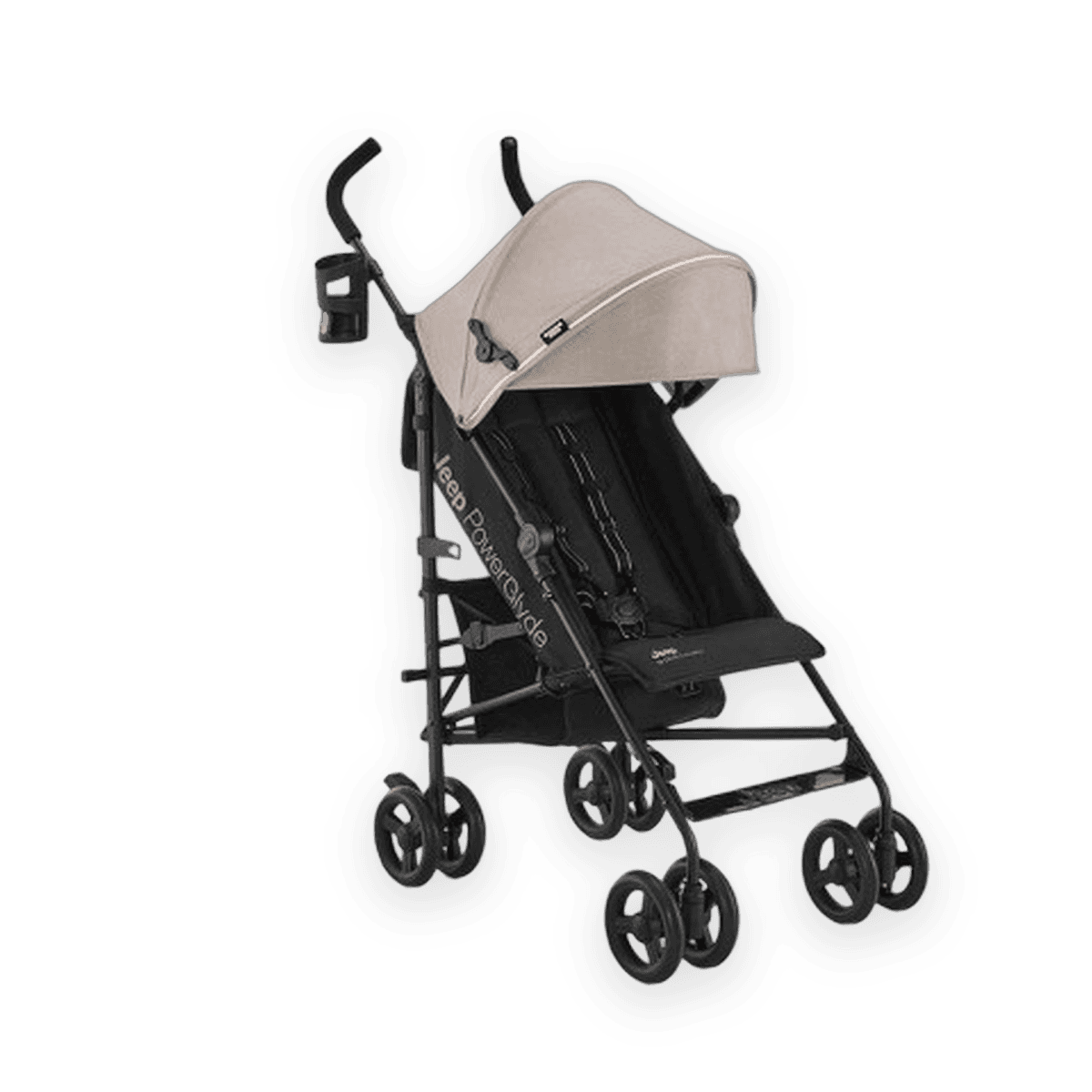
Product image via Target
Where to buy
Prices checked Sep 23, 2026- TargetCheck price at Target
We may earn a commission from links on this page, at no extra cost to you. How this works.
15 min read · Reviewed by Huggle Hive Editorial Team, Parent-led product research team · Updated August 2, 2026
The Jeep PowerGlyde by Delta Children is a stage-two stroller. It weighs 13.7 pounds, folds umbrella style with an auto lock and a built-in carry handle, and is rated for infants 9 months up to 50 pounds, which means a newborn cannot ride in it. On its verified specs it earns a Hive Score of 8.1 out of 10: light and well shaded, with a narrow job description.
Our scorecard
How the Hive Score works- Portability
- 4.3
- Safety basics
- 4.0
- Comfort & ride
- 4.2
- Versatility
- 2.6
- Value
- 3.7
Scores blend each product's verified specs with its overall owner rating, weighted the same way for every stroller. Learn more about our evaluation framework.
The short version
- 13.7 pounds on a steel frame, with a compact umbrella fold, an auto lock and a carry handle.
- Rated for infants 9 months and up to a 50 pound maximum, so it picks up where the infant car seat leaves off.
- JPMA certified, with a five-point harness.
- Extra-large extendable canopy with a UPF 50+ sun visor, plus a three-position recline.
- Car seat compatibility, a bassinet and a reversible seat are not part of its confirmed spec, which is why versatility is its lowest sub-score.
Pros
- At 13.7 pounds, light enough to carry in one arm while your child rides in the other
- Folds to 9.5 by 6.7 inches through the body, so it tucks into a hall closet or beside a trunk load
- Auto lock holds the fold closed and the carry handle is built in, not an accessory
- JPMA certified and fitted with a five-point harness
- Extendable canopy with a UPF 50+ sun visor for real shade on long walks
- 50 pound weight limit means years of use, not months
- Parent cup holder and a large storage basket come standard
Cons
- Not for newborns: the age rating starts at 9 months
- Car seat compatibility is not part of the confirmed spec, so it will not cover the first-months gap
- At 41.7 inches long folded, it is a gate-check stroller, not an overhead-bin one
- An adjustable handlebar and suspension are not part of the confirmed spec, which matters if you are tall or push on rough ground
- Versatility is its weakest score at 2.6 out of 5
Who is the Jeep PowerGlyde for?
You have a baby who sits up confidently, a car seat that no longer clicks into anything you enjoy pushing, and a full-size stroller you have started to resent every time you load the trunk. That is the moment this stroller answers. It is built for the walking-around stage: park loops, grocery runs, airport terminals, the long haul through a zoo when a nine-month-old still needs to nap sitting up.
It suits families who travel. A 13.7 pound frame with an auto-locking fold and a carry handle is the kind of thing you can hoist over a turnstile or into an overhead luggage rack at a train station, and the slim folded profile means it does not eat the entire trunk when the suitcases are already in. The 50 pound ceiling also makes it a long-term keeper, the stroller that stays in the car for a four-year-old who still fades halfway through a museum.
Skip it if you are shopping for your first stroller and your baby is not born yet. The 9-month rating rules out newborns, and pairing it with an infant car seat is not something its confirmed spec supports. Skip it too if your daily route involves gravel, grass or broken sidewalks: suspension and all-terrain wheels are not part of what has been verified here, so treat it as a smooth-surface stroller. Tall parents should check the handlebar in person, since an adjustable handle is not part of the confirmed spec either.
How does it perform day to day?
Portability: the number that defines this stroller
13.7 pounds is the headline, and it is the reason portability scores 4.4 out of 5, the highest of the five categories. Full-size strollers and travel-system frames typically weigh considerably more, and that difference is felt every single time you lift, not just on paper. The fold matters as much as the weight: 9.5 inches long by 6.7 inches wide through the body means it stands in the gap behind a coat rack or slides down the side of a packed trunk instead of claiming the middle of it.
Two details do a lot of quiet work. The auto lock keeps the stroller closed once folded, so it does not sag open while you are carrying it and a bag and a toddler. The carry handle is part of the design rather than an afterthought, which is what makes a one-armed stair climb realistic.
The catch is the third dimension. Folded height is 41.7 inches, roughly three and a half feet. That is a cane-shaped fold, not a cube, and it will not go in an airplane overhead bin. Plan on gate-checking it, which is standard practice for a stroller this size and not a mark against it, as long as you go in expecting it.
Handling: what the front wheels actually do
Delta Children credits the PowerGlyde's handling to new front wheels with what the company calls precision technology, and says the design makes it easier to glide, turn and maneuver. That is the manufacturer's claim, and we would read it as marketing language for the confirmed spec underneath: swivel front wheels on a steel frame.
Swivel front wheels are the right choice for what this stroller is for. They pivot for tight turns down a supermarket aisle or through a crowded terminal, which is where a lightweight stroller earns its keep. What is not in the verified data is wheel size, suspension or an all-terrain designation, so we would not steer you toward it as a trail or beach stroller. On pavement, tile and mall flooring, the swivel setup is the format that works.
The steel frame is worth a sentence of its own. Steel is a heavier material than the aluminum used on many compacts, which makes hitting 13.7 pounds with it a reasonable structural result, and Delta Children describes the frame as durable.
Comfort: recline, canopy, and shade that lasts
The seat has a three-position recline, per Delta Children. Multi-position recline is the feature that decides whether a stroller works for naps, and three positions gives you an upright setting for snack time, a middle setting for cruising, and a laid-back setting for the child who has given up. Whether the deepest position lies flat is beside the point here, because the stroller is rated from 9 months and a lie-flat setting is a newborn requirement.
The canopy is the part we would call out to any parent shopping for a summer stroller. It is an extra-large extendable canopy with a UPF 50+ sun visor. UPF 50 is a measured rating, not a marketing adjective: fabric rated UPF 50 allows about one-fiftieth of UV radiation through, which is roughly 98 percent blocked. For a child too young for broad sunscreen coverage on every exposed inch, a canopy that extends down toward the footrest is the practical difference between a comfortable afternoon and a red forehead.
Comfort and ride lands at 4.2 out of 5, and the recline and the UPF 50 canopy are why.
Safety and build: what JPMA certification means
The PowerGlyde is JPMA certified and uses a five-point harness. Those two facts carry more weight than most spec-sheet lines.
JPMA certification means the product was submitted to an independent, third-party testing program against the applicable ASTM safety standard for its category, rather than self-declared as safe by the brand. It is a voluntary program, so its presence is a real signal and its absence on a competitor is not proof of anything.
A five-point harness secures at both shoulders, both hips and between the legs. It is the configuration you want for a child who has learned to lean, arch and slide, and it is meaningfully harder to escape than a three-point setup. Use it every ride, and snug the straps so you can slip only a finger underneath. The AAP's stroller safety guidance is also clear that a reclined stroller seat is not a safe sleep surface: if your child falls asleep on a walk, move them to a firm, flat sleep space once you are home. For recalls and general standards, the CPSC's carriage and stroller safety center is the place to check before you buy secondhand.
The small stuff that decides whether you use it
Delta Children includes an extra-large storage basket and a parent cup holder. A basket that swallows a diaper bag is what keeps a lightweight stroller from becoming a thing you hang bags off the handles of, which is how strollers tip. The cup holder is for you, not the baby, and after six months of one-handed coffee you will care about it more than you expect to.
The PowerGlyde does one job and does it lightly. It is not the stroller that grows with you from the hospital; it is the one that makes month nine onward easier to carry.
Fit and sizing: who fits, and for how long
The age floor is the number to plan around. This stroller is recommended for infants 9 months up to 50 pounds. That lower bound reflects the seat's support structure, and it is not a suggestion to negotiate with.
The upper bound is generous. Plenty of children reach 50 pounds somewhere around kindergarten age, which means a stroller bought at nine months can plausibly stay in rotation for four years or more. That longevity is the strongest value argument this stroller has.
| Spec | Measurement |
|---|---|
| Stroller weight | 13.7 lb |
| Age range | 9 months to 50 lb |
| Open dimensions | 33.9"L x 18.5"W x 41.3"H |
| Folded dimensions | 9.5"L x 6.7"W x 41.7"H |
| Frame material | Steel |
| Harness | Five-point |
| Recline | Three-position |
| Canopy | Extendable, UPF 50+ |
| Certification | JPMA certified |
| Type | Lightweight |
Two of those numbers deserve translation. Open width is 18.5 inches, which clears standard interior doorways and most retail aisles without a shuffle. Open height is 41.3 inches overall, and since an adjustable handlebar is not part of the confirmed spec, a taller parent should push it once before committing to avoid the shin-clipping stride that a fixed low handle can cause.
Seat width and seat back height are not published in the verified data, so we will not guess at them. If you are buying for a long-legged three-year-old rather than a baby, that is the dimension to check in person.
What you are paying for
A lightweight stroller is priced on what it leaves out as much as what it includes. Here is the honest ledger for this one.
What is included as standard:
- A UPF 50+ extendable canopy, which on many compacts is a small fixed visor
- A three-position recline rather than a single fixed seat angle
- A five-point harness and JPMA certification
- An extra-large storage basket and a parent cup holder
- A 50 pound ceiling, which is a high limit for an umbrella-fold stroller
What you are not paying for:
- Newborn use, in any configuration
- A confirmed car seat click-in, a bassinet or a reversible seat
- Confirmed suspension, all-terrain wheels or an adjustable handlebar
That second list explains the two-stroller math most families end up doing anyway. If you buy a travel system for months zero through nine and add the PowerGlyde after, you are spending on two products. The counter-argument is use: a stroller that stays useful to 50 pounds spreads its cost across years rather than seasons, and the one you actually carry is the one that gets used. A gorgeous full-size stroller left in the garage costs infinitely more per ride.
How does it compare to other kinds of strollers?
Against a full-size travel system
A travel system covers the newborn stage by taking an infant car seat, and it typically brings a plusher seat, bigger wheels and a heavier frame. The PowerGlyde cannot do the first part at all, and does not claim to. What it offers instead is the thing travel systems consistently lose on: weight and fold size. If you own both, the travel system handles the first nine months and the PowerGlyde handles everything you would rather not lift. If you can only own one, and your baby is not born yet, this is not the one.
Against a bare-bones umbrella stroller
The cheapest umbrella strollers get you a seat, a frame and not much else. Against that group, the PowerGlyde is carrying real equipment: an extendable UPF 50+ canopy, a three-position recline, a five-point harness, a large basket and a cup holder, on a JPMA certified frame. If you are choosing between this and a stripped-down cane stroller for a child who naps on the go or spends real time outdoors in summer, the recline and the canopy are the two features worth paying up for.
Against a compact travel stroller
The premium compact category exists to solve one problem: folding small enough for an airplane overhead bin. The PowerGlyde does not solve that problem. Its fold is narrow but 41.7 inches long, so it gate-checks. If you fly monthly, that difference will matter more than anything else on the spec sheet. If you fly twice a year and drive constantly, the slim trunk fold and the 13.7 pound carry weight are worth more to you than bin compliance.
For a wider look at how the category sorts out, our lightweight stroller guide and our full stroller reviews cover the alternatives in detail.
How we scored it
The Hive Score of 8.1 out of 10 is the average of five sub-scores, each computed from the verified attributes rather than written by hand. You can read the full method on our review methodology page.
Portability, 4.4. The highest score on the card, and the least surprising one. A 13.7 pound weight puts it firmly in light territory, and the one-hand-friendly umbrella fold with an auto lock and carry handle adds to it. The folded height is what keeps it from going higher.
Comfort and ride, 4.2. Driven by the three-position recline and the UPF 50+ canopy. It would climb further with confirmed suspension or an adjustable handlebar, neither of which is part of this stroller's verified data.
Safety basics, 4.0. This category starts from a deliberately conservative baseline, then earns its way up. JPMA certification and the five-point harness both count here, and together they carry it to a solid result.
Value, 3.7. Just above the middle. The standard-equipment list (canopy, recline, basket, cup holder, five-point harness) supports it, and the 50 pound ceiling stretches the useful life. What holds it back is how specific its role is.
Versatility, 2.6. The clear weak point, and worth understanding rather than glossing over. This score rewards strollers that reconfigure: car seat compatibility, a bassinet, a reversible seat, a second seat, newborn readiness. The PowerGlyde's credit here comes from its multi-position recline, and the 9-month starting age rules out the newborn portion entirely. It is not a flaw in the build. It is the honest cost of a stroller designed to be light and simple.
Where to buy the Jeep PowerGlyde
Stock and pricing shift on lightweight strollers more than on any other category, so check the current listings above before you commit.
Can a newborn use the Jeep PowerGlyde Stroller?
No. Delta Children recommends this stroller for infants 9 months and up. Follow that rating rather than judging by how deep the recline looks, since the age minimum reflects the seat's support structure.
How long will my child fit in it?
The maximum child weight is 50 pounds, which many children do not reach until around kindergarten age. Bought at 9 months, it can realistically stay in the car for several years.
Does it work with an infant car seat?
Car seat compatibility is not part of this stroller's confirmed spec, and the 9-month age rating points the same direction. If you need a click-in setup for the newborn months, a travel system is the product to shop for.
Is it good for air travel?
It is a gate-check stroller. At 13.7 pounds with a carry handle and an auto-locking fold, it is easy to move through a terminal, but the folded length of 41.7 inches is far too long for an overhead bin.
How much sun protection does the canopy give?
The canopy is extendable and carries a UPF 50+ sun visor. A UPF 50 rating means the fabric lets roughly one-fiftieth of UV radiation through, blocking about 98 percent of it.
Is it safe for my baby to nap in?
The three-position recline is comfortable for a rest on a walk, and the five-point harness should stay buckled the whole time. The AAP is clear that a stroller seat is not a safe sleep surface, so move your child to a firm, flat sleep space once you are home.
Can I use it on grass, gravel or trails?
We would not plan on it. Suspension, wheel size and an all-terrain designation are not part of the verified spec, so treat the PowerGlyde as a sidewalk, mall and airport stroller. Its swivel front wheels are built for tight turns on smooth surfaces.
The bottom line
The Jeep PowerGlyde is an honest lightweight stroller that knows its job. For 13.7 pounds you get a JPMA certified steel frame, a five-point harness, a genuinely large UPF 50+ canopy, a three-position recline, a basket and a cup holder, all folding down to a 9.5 by 6.7 inch profile that fits where a full-size stroller cannot. That combination earns an 8.1.
The trade-off is spelled out in the age rating. This stroller starts at 9 months and does not take a car seat, so it is the second stroller in most homes, not the first. If your baby is already sitting up and your current stroller has become the reason you dread the trunk, this is a straightforward upgrade that will still be useful when your child is far too big for the one you own now.
Delta Children Jeep PowerGlyde Stroller
See prices