
Delta Children Jeep PowerGlyde Plus
Price verified Sep 23, 2026 · lowest in 90 days $94.99
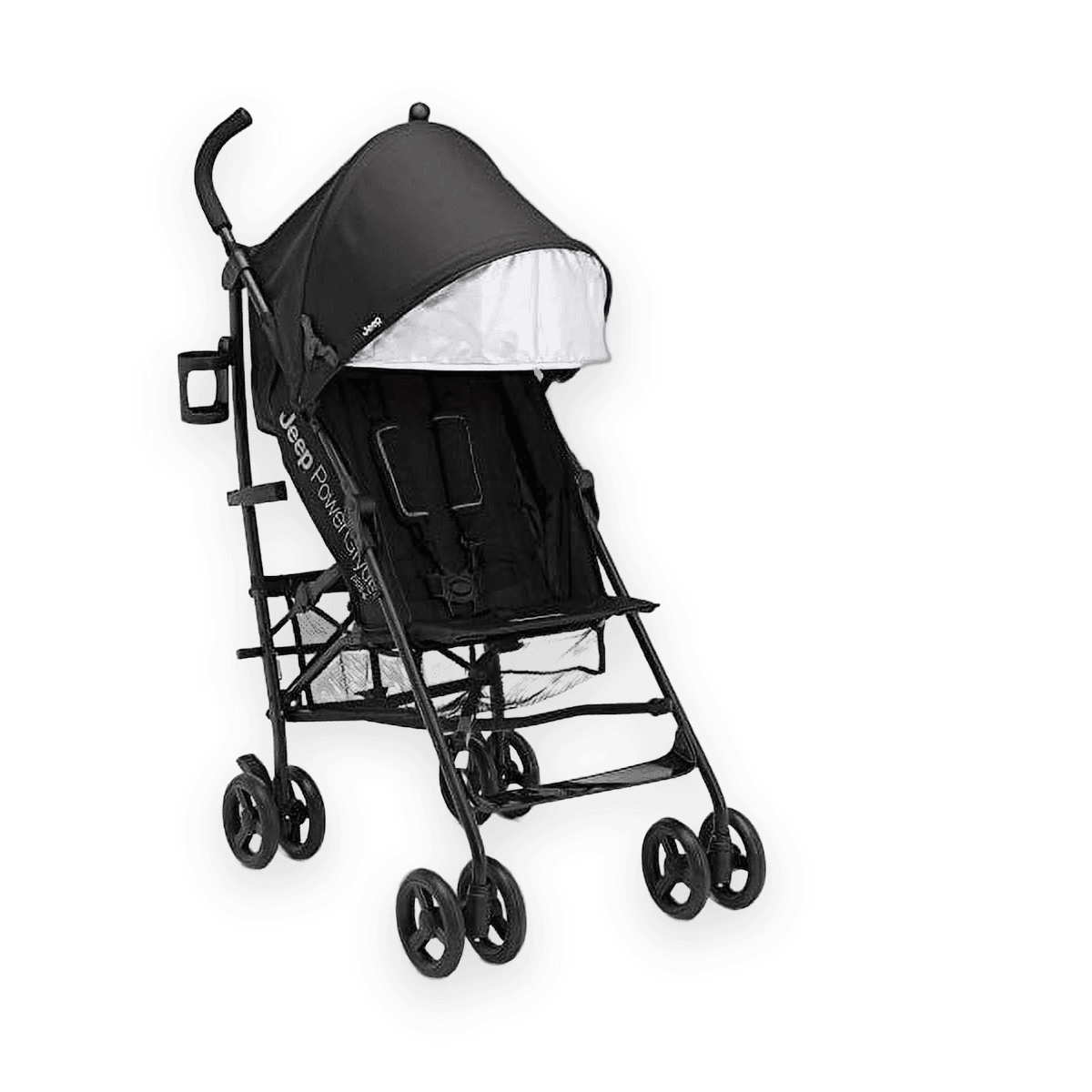
Product image via Walmart
Where to buy
Prices checked Sep 23, 2026- WalmartCheck price at Walmart
We may earn a commission from links on this page, at no extra cost to you. How this works.
16 min read · Reviewed by Huggle Hive Editorial Team, Parent-led product research team · Updated August 3, 2026
Buy the Jeep PowerGlyde Plus if the hardest part of your day is the stroller itself: carrying it up subway stairs, folding it at a gate with a boarding pass in your teeth, or lifting it into a trunk while a baby squirms on your hip. Delta Children lists it at under 14 pounds on an aluminum frame, with a compact umbrella fold, an auto lock, and a carry handle, and it seats a child from 6 months up to 50 pounds. The trade is straightforward: no newborn use, no travel system, no all-terrain ambitions, in exchange for a frame you can pick up with one arm.
The short version
- Rides from 6 months up to 50 pounds, so it covers the sitting-up stage well into the preschool years.
- Aluminum frame with a compact umbrella fold, an auto lock, and a carry handle.
- Five-point harness and a four-position reclining seat, per Delta Children.
- Extra-large extendable canopy with a UPF 50+ sun visor, per Delta Children.
- Extra-large storage basket, a cup holder, and swivel front wheels.
- Hive Score 8.3 out of 10. Versatility is the weak spot at 2.6 out of 5.
The spec sheet, in one glance
| Spec | What Delta Children lists |
|---|---|
| Weight | Under 14 pounds |
| Frame | Aluminum |
| Age and weight range | Infants 6 months up to 50 pounds |
| Harness | Five-point |
| Recline | Four-position |
| Canopy | Extra-large extendable canopy with a UPF 50+ sun visor |
| Fold | Compact umbrella fold, auto lock design, carry handle |
| Wheels | Swivel front wheels |
| Storage | Extra-large storage basket, cup holder |
| Stroller type | Lightweight |
Pros
- Compact umbrella fold with an auto lock and a carry handle, built for stairs, trunks, and gate checks
- Light aluminum frame instead of steel, which is where the low weight comes from
- Five-point harness rather than a three-point lap-and-shoulder belt
- Four-position recline, per Delta Children, instead of one fixed seat angle
- Extra-large extendable canopy with a UPF 50+ sun visor, per Delta Children
- 50 pound ceiling gives it a long runway past toddlerhood
- Extra-large basket plus a cup holder, so bags are not hanging off the handles
Cons
- Not a newborn stroller. Delta Children starts it at 6 months
- Versatility scores 2.6 out of 5: no travel system use, reversible seat, or bassinet use is documented
- Swivel front wheels on a light frame suit pavement better than grass, gravel, or broken sidewalk
- Folded dimensions and seat measurements are not published, so trunk and cabin fit are hard to plan
- Safety certifications are not part of the listed specs, which holds Safety basics to 3.8 out of 5
Who is this stroller for?
Get it if you carry more than you push. City parents, families who fly, and anyone whose building has stairs will feel the weight difference every single day. The umbrella fold and carry handle are the whole pitch here, and they are aimed squarely at the moment when the stroller has to become luggage.
It also fits families who already own a big stroller and want a second one that lives in the trunk. If your full-size seat eats the cargo space you need for a stroller plus a week of groceries, a lightweight frame solves that without asking you to give up a five-point harness or a reclining seat.
Skip it if your baby is under 6 months. That is not a preference, it is the manufacturer's stated range, and it rules out the newborn window entirely. Skip it too if you want one stroller to do everything: nothing in the published specs supports car seat attachment, a second seat, or a reversible seat, so a family planning for a travel system or a sibling setup should look at a different shape of stroller. And if your daily route runs across park grass, trail gravel, or heaved sidewalk, we would steer you toward an all-terrain frame with bigger wheels.
A lightweight stroller is a specialist. This one specializes in being carried, and it holds onto a five-point harness and a reclining seat while doing it.
How does it perform day to day?
Folding, carrying, and getting through a door
An umbrella fold collapses the frame inward along its length into a long, narrow bundle, which is a different shape from the flat rectangular fold of a full-size stroller. Narrow beats flat when you are threading a train turnstile or standing it in a hall closet. Flat beats narrow when you are packing a trunk around a suitcase, so the shape is a real choice, not a lesser version of the same thing.
The auto lock is the part that matters more than it sounds. It is a latch that catches when the frame closes, holding it shut while you move it, which is the difference between carrying a stroller and wrestling one. Pair that with the carry handle and you get a one-armed lift instead of a pinch grip on a folded frame.
Under 14 pounds on an aluminum frame is the number doing the work. Aluminum keeps the mass down while staying rigid, and that weight class is the reason this stroller earns a Portability score of 4.2 out of 5. Delta Children does not publish folded dimensions, so if your plan involves a specific overhead bin or a specific trunk well, measure the space and confirm before you commit.
How does it handle on the sidewalk?
Swivel front wheels pivot freely on their own axis instead of tracking straight, so the stroller changes direction when you push on one side of the handle. That is what makes tight turns in a store aisle and one-handed steering possible while your other hand holds a coffee or a toddler. It is the right setup for smooth, hard surfaces.
The flip side is physics. A light frame carries less mass over the wheels, so lips in the pavement, thick grass, and loose gravel deflect it more than they would a heavier stroller. We would treat this as a paved-route stroller: sidewalks, airport concourses, mall floors, boardwalks.
Is the seat comfortable enough for naps?
Delta Children lists a four-position reclining seat. The count is less useful than the angle: what actually decides whether a stroller works for naps is how far the deepest position drops. Delta Children does not state that the deepest position lies flat or near flat, so we cannot tell you it does.
Here is why that matters at this exact age. A baby right at the 6 month starting line is often still taking two naps a day, and a seat that stops at a mild lean is a seat your baby fights at 11am. Sit the stroller down in a store, push the recline to its lowest setting, and decide with your own eyes whether that angle is a nap or just a lounge. If most of your outings are timed around wakeful windows, the question matters far less.
Comfort and ride is the strongest sub-score on the card at 4.3 out of 5, carried by the multi-position recline and the canopy coverage rather than by any suspension claim.
What does UPF 50+ actually buy you?
Delta Children lists an extra-large extendable canopy with a UPF 50+ sun visor. UPF is a fabric rating, not a sunscreen rating: a UPF 50 rating means the fabric is tested to let through roughly one fiftieth of the UV that hits it. Extendable means the shade pulls forward as the sun drops toward the horizon, which is when a fixed canopy stops helping.
Shade is the first line of sun protection for a baby, and the American Academy of Pediatrics guidance at HealthyChildren.org leans on shade and clothing before sunscreen for the youngest kids. Worth remembering: a canopy blocks direct overhead sun, not the UV bouncing up off sand, water, or concrete. Sunglasses, a hat, and timing still do work the canopy cannot.
Safety basics: the harness and the handle
The five-point harness is the piece we would not compromise on. Five points means two shoulder straps, two hip straps, and a crotch strap meeting at a central buckle, which spreads restraint across the strongest parts of the body and, just as practically, makes it much harder for a determined toddler to stand up and climb out the top. A three-point belt does neither as well.
Two habits matter more than any spec. Do not hang a diaper bag or shopping bags from the handle, because weight up high and behind the rear axle is how a light stroller tips backward. And check your model against the CPSC recall database after you buy, then once or twice a year after that.
Safety basics sits at 3.8 out of 5. The five-point harness is credited. Third-party certification, the kind tracked through programs like JPMA certification, is not part of the listed specs for this model, so the score does not include that credit.
Storage, the cup holder, and the small stuff
Delta Children lists an extra-large storage basket and a cup holder. A basket you can actually load is the feature that decides whether you bring the stroller or the carrier on a grocery run, and a cup holder saves you from the balancing act at the coffee counter.
One thing to check in person on any umbrella-fold frame: where the rear crossbar sits relative to the basket opening, because that geometry, not the stated basket size, is what determines whether you can grab a bag without stopping and crouching.
What ages and sizes does it fit?
The range is infants 6 months up to 50 pounds. The bottom of that range is the hard stop. A stroller rated from 6 months assumes a baby with steady head and trunk control, and it is not designed to hold a newborn who needs a flat surface. Families who want stroller coverage from birth need either a bassinet-capable frame or an infant car seat that clicks into one.
The top of the range is generous. A 50 pound ceiling covers most kids well into the preschool years, past the point where most stop asking to ride at all. In practice the limiter usually is not weight. It is legroom and seat height: kids outgrow the footwell before they outgrow the frame. Delta Children does not publish seat dimensions, so if you have a tall three-year-old, treat the 50 pound number as a ceiling rather than a promise about fit.
A reasonable read on lifespan: this is a stroller that could plausibly serve from the sitting-up stage through the theme-park years, with the caveat that older kids fit better in strollers with taller seat backs.
What are you actually paying for?
This one is easy to summarize because the feature list is short and honest.
- The weight. Aluminum instead of steel is the single biggest reason to choose this over a cheaper frame.
- The fold system. Umbrella fold, auto lock, carry handle. Three parts of one idea, which is that the stroller has to travel too.
- The safety and comfort floor. A five-point harness and a four-position recline, which is more than the barest lightweight strollers include.
- The canopy. Extra-large, extendable, with a UPF 50+ sun visor, per Delta Children.
- The parent conveniences. Extra-large basket and a cup holder.
What you are not paying for: car seat compatibility, a reversible seat, a second seat, or documented suspension. Those absences are exactly what shows up in the Versatility score.
How does it compare to other strollers?
Three different shapes of stroller compete for this spot in your closet, and the honest comparison is structural rather than model by model.
Against a full-size travel system. A travel system frame accepts an infant car seat, which means it works from day one and lets you move a sleeping newborn from car to sidewalk without unbuckling. It also typically has a deeper recline, a taller seat, and better wheels. It weighs two to three times what this does, and it eats your trunk. Pick the travel system if this is your only stroller and your baby is not yet 6 months. Pick the PowerGlyde Plus once your baby is sitting up and the daily pain point has shifted from newborn logistics to hauling.
Against other lightweight and umbrella strollers. This is the closest category, and the differences come down to three things: what the frame is made of, whether the recline is real or token, and whether the fold locks itself. Aluminum, four positions, and an auto lock put this at the more equipped end of the lightweight class. The cheapest umbrella strollers usually give up the reclining seat first and the five-point harness second, which is a bad trade for a baby who naps on the go. The premium travel strollers go the other way and add cabin-size folds and better wheels for a significant price step.
Against an all-terrain or jogging stroller. Bigger air-filled or foam wheels and real suspension change what surfaces you can use. If your walks involve trails, grass, or genuinely rough sidewalk, that hardware is worth its weight, and there is no lightweight frame that substitutes for it. But a jogger is a poor airport companion and a worse closet guest. Plenty of families end up owning one of each, which is exactly the second-stroller role this fills.
If you want to see how the whole class stacks up, our lightweight stroller guide ranks the category, and the rest of the brand's lineup is at our Delta Children reviews hub.
How we scored it
The Hive Score is 8.3 out of 10, built from five sub-scores.
Portability, 4.2 out of 5. The highest-leverage score for this stroller and the reason to buy it. Sub-14-pound weight on an aluminum frame plus a compact umbrella fold with an auto lock and a carry handle is the full portability package.
Comfort and ride, 4.3 out of 5. The top score on the card. The multi-position recline and the extendable UPF 50+ canopy both feed this, since shade and seat angle are what a child actually experiences. No suspension is documented, which is where the remaining ground sits.
Safety basics, 3.8 out of 5. The five-point harness earns credit. Third-party certification is not part of the published spec for this model, so no certification credit is applied. Nothing here suggests a problem, only that the paperwork we score on is not on the sheet.
Versatility, 2.6 out of 5. The weakest number, and it is fair. This dimension builds from a low base and rises only when a stroller documents things like travel system compatibility, a reversible seat, newborn readiness, a bassinet option, or a second seat. This is a single-seat lightweight stroller that starts at 6 months, so the multi-position recline is most of what it earns. That is a design choice, not a defect, but it does mean this is rarely the only stroller a family owns.
Value, 3.7 out of 5. Anchored by the price tier and nudged by the overall rating, it lands slightly above the middle. You are paying for aluminum and a fold system, and getting a reclining seat and a real canopy along with it. More detail on the method is on our stroller review methodology page.
Can a newborn use the Jeep PowerGlyde Plus?
No. Delta Children recommends it for infants 6 months up to 50 pounds, so it is not designed for the newborn stage. Families who need stroller coverage from birth should look at a frame that takes an infant car seat or a bassinet.
How long will my child fit in it?
The stated ceiling is 50 pounds, which covers most kids into the preschool years. In practice, legroom and seat height usually run out before weight does, and Delta Children does not publish seat dimensions, so treat 50 pounds as a maximum rather than a fit guarantee for a tall child.
Does the seat recline enough for naps?
Delta Children lists a four-position reclining seat. The deepest angle is not specified, and it is not described as lying flat. If stroller naps are a daily part of your routine, check the lowest position yourself before buying.
How good is the canopy for sun protection?
Delta Children lists an extra-large extendable canopy with a UPF 50+ sun visor. A UPF 50 rating means the fabric is tested to block the large majority of UV that hits it, and extendable means you can pull the shade forward as the sun drops. Shade does not stop UV reflected up off pavement, sand, or water, so a hat still helps.
Does it work with an infant car seat or as a travel system?
Car seat compatibility is not part of the published specs for this model, and the 6 month starting age points the same direction. Plan on it as a standalone stroller.
Will it fold small enough for a car trunk or a flight?
It uses a compact umbrella fold with an auto lock and a carry handle, which produces a long, narrow bundle rather than a flat one. Delta Children does not publish folded dimensions, so measure your trunk well or confirm your airline's stroller policy rather than assuming cabin size.
Is a five-point harness worth insisting on?
Yes. Five points spread the restraint across both shoulders, both hips, and between the legs, which keeps a child seated and makes climbing out much harder than a three-point belt allows. This stroller has one.
Where to buy the Jeep PowerGlyde Plus
Colorways and stock move around, so compare the current listing price against the return policy before you decide. If you are buying it as a travel stroller, buy early enough to fold and unfold it a few times at home rather than for the first time at a gate.
Bottom line
The Jeep PowerGlyde Plus is a specialist that knows what it is. It gives you a genuinely light aluminum frame, a fold system designed around carrying rather than just closing, a five-point harness, a four-position recline, and an extendable UPF 50+ canopy, for a child from 6 months to 50 pounds. The cost of that focus is versatility: no newborn stage, no travel system, and no reason to take it off pavement.
If you are shopping for one stroller to do everything from birth, this is not it. If your baby is sitting up and your real problem is stairs, trunks, and terminals, an 8.3 here is well earned.
Delta Children Jeep PowerGlyde Plus
See prices