
Delta Children Jeep Gladiator 4 Seater Stroller Wagon
Price verified Sep 15, 2026 · lowest in 90 days $499.99
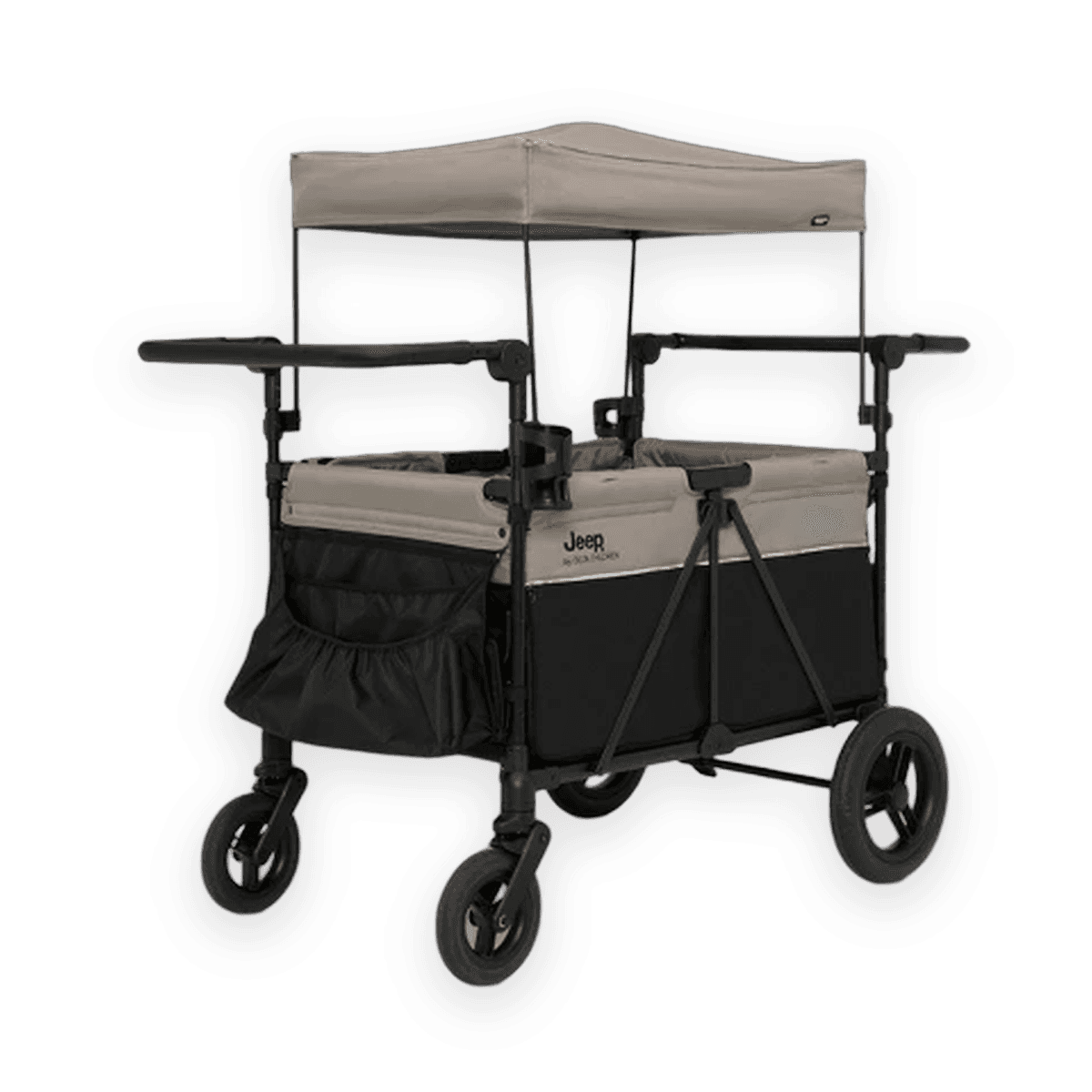
Product image via Target
Where to buy
Prices checked Sep 15, 2026- TargetCheck price at Target
- Brand siteCheck price at Brand site
We may earn a commission from links on this page, at no extra cost to you. How this works.
16 min read · Reviewed by Huggle Hive Editorial Team, Parent-led product research team · Updated September 23, 2026
The Jeep Gladiator 4-Seater Stroller Wagon is built to move four small kids and everything they drag along with them, and it does it without add-on seats or a second push handle. Jeep rates it for 6 months to 42 inches, 50 pounds per seat and 200 pounds total, and it carries both GREENGUARD Gold and JPMA certification. The catch is size and cost: this is a 56.5-inch-long wagon that still stands 42.5 inches tall when folded, and value is the lowest mark on its scorecard.
Our scorecard
How the Hive Score works- Portability
- 5.0
- Safety basics
- 5.0
- Comfort & ride
- 5.0
- Versatility
- 3.7
- Value
- 3.4
Scores blend each product's verified specs with its overall owner rating, weighted the same way for every stroller. Learn more about our evaluation framework.
The short version
- Four seats, 50 lbs each, 200 lbs total, rated by Jeep for 6 months up to 42 inches tall
- GREENGUARD Gold and JPMA certified, with a five-point harness and a foot brake
- Travel-system compatible with a specific list of infant car seats, including Chicco KeyFit 30 and Britax B-Safe 35
- Seats convert: face them forward, backward, inward, or split, or pull them out and haul gear
- Folded it is 31.1 x 29.5 x 42.5 inches, so measure your trunk before you commit
Pros
- Four seating spots with a 200 lb total capacity, which is genuinely rare without buying add-ons
- GREENGUARD Gold certified and JPMA certified, two independent marks that most wagons do not carry together
- Five-point harness rather than a lap belt, which matters more in a wagon than in a stroller
- Travel-system compatible with named infant seats (Graco SnugRide 30/35/40, Evenflo Embrace, Evenflo Nurture, Chicco KeyFit 30, Britax B-Safe 35, Britax B-Safe Gen 2)
- Two adjustable leatherette handlebars, so a 5-foot-2 parent and a 6-foot-2 parent can both push comfortably
- Removable canopy with roll-down mesh screens or blackout panels for naps
- Real storage: side pockets, zippered compartments under the seats, a kids snack tray, and two parent cup holders
- Large puncture-proof tires, so no pump and no flats
- One-hand fold that goes flat for storage and transport
Cons
- 56.5 inches long and just under 30 inches wide open, which is tight in shop aisles and narrow doorways
- Folded height of 42.5 inches asks a lot of a sedan trunk
- Starts at 6 months, so it is not a newborn's first ride unless you use a compatible infant car seat
- Value is the weakest sub-score at 3.4 out of 5, reflecting the price tier this wagon sits in
- Wagon weight and suspension are not confirmed specs, so lifting effort and ride cushioning are unknowns
- Four seats is more wagon than most two-kid families need
Who it's for, and who should skip it
Buy this if you are outnumbered. Three kids under five, or two of your own plus a regular cousin and a neighbor, or twins with two older siblings who fade after half a mile. The 200-pound total capacity and 50 pounds per seat mean the wagon keeps working well past the age when most families have already retired the double stroller.
It also fits a specific kind of outing. Zoo days, beach days, campgrounds, tailgates, long stretches of pavement where kids climb in and out ten times. Jeep's drop-down rail is designed for exactly that, letting a four-year-old board without being lifted, and freeing up legroom the rest of the time.
Skip it if you have one or two kids. You would be pushing nearly five feet of wagon to carry a load a two-seater handles, and you would be paying for seats that ride empty. Skip it too if you live up a walk-up or drive a compact car, because a 42.5-inch folded height does not disappear into a small trunk or a hall closet. And if your baby is not yet 6 months old and you do not plan to use one of the compatible infant car seats, this is not your first ride.
Four seats is the whole argument. The certifications, the storage, the convertible layout, and the fold all exist to make four seats livable for one adult pushing alone.
Performance
Can it actually hold four kids?
Yes, and the layout is the interesting part. The wagon seats four in two facing pairs, and Jeep says the pairs can be set to face forward, face backward, turn inward toward each other, or split so one pair looks one way and the other looks the other. Pull the seats out entirely and the same shell becomes a gear hauler for coolers, beach bags, and folding chairs.
Why that matters at 3pm on a long day: a four-year-old who wants to watch where you are going and a toddler who wants to see your face can both get what they want without a fight. Turning the pairs inward gives you a rolling snack table with the tray in the middle. Turning them outward gives you two kids who are not touching each other, which some days is the entire goal.
Capacity is where the numbers back the pitch. Fifty pounds per seat and 200 pounds total is enough for four preschoolers, not just four babies. Jeep caps the range at 42 inches of height, and for most kids height runs out before weight does, which is worth keeping in mind if you have a tall three-year-old.
Is it safe enough for a 6-month-old?
The certification stack here is the strongest thing on the spec sheet. This wagon is JPMA certified, meaning it has been tested to the relevant juvenile product safety standard by a third party, and GREENGUARD Gold certified, which is a chemical-emissions standard for the materials themselves. Plenty of wagons carry one. Carrying both is unusual, and it is a large part of why safety basics lands at 5.0 out of 5.
The harness is five-point, not a lap belt. In a wagon this matters more than it does in a stroller, because kids sit on a flat bench with no bucket seat holding them in place, and a curious one-year-old can stand up in a lap belt. Five points keep the shoulders down.
Braking is a foot brake, the standard arrangement on wagons of this size. Set it any time you stop on a slope, and keep the brake habit even on flat ground, because 200 pounds of loaded wagon rolls farther than you expect. The CPSC's stroller and wagon guidance is worth two minutes of reading if this is your first wheeled carrier.
On the youngest rider: Jeep's recommendation starts at 6 months, which is roughly when most babies sit unassisted. The wagon is travel-system compatible with a named list of infant seats, and that is the route for a younger sibling. Follow the manual for how the car seat attaches before the first outing.
How does it ride?
The tires are the headline. They are large and puncture-proof, which does two things for you: they roll over grass, gravel, packed sand, and curb transitions better than small hard plastic wheels, and you never have to find a pump or patch a flat before a trip. For a wagon that is going to spend its life on campground paths and fairground grass, that is the right call.
Whether there is a suspension system is unconfirmed, so plan on the tires doing the cushioning work rather than springs. On broken pavement, a loaded wagon will still transmit some of the bumps.
Two adjustable leatherette handlebars solve a problem most wagons ignore. Single-handle wagons force one pushing height on every adult in the family, and the short parent ends up with their arms up while the tall one stoops. Two handlebars, both height-adjustable, mean either parent can take a turn without renegotiating the setup, and it also gives you a second grip position for hills.
The canopy is removable, with roll-down mesh screens for airflow or blackout panels when a kid needs to nap mid-outing. That blackout option is the one parents underrate. A nap that happens in the wagon is an extra two hours of day. The canopy's UPF rating is unconfirmed, so treat it as shade rather than as documented sun protection, and keep sunscreen and hats in the rotation.
Where does everything go?
Storage is where this wagon earns its keep on a real outing. There are side storage pockets, zippered compartments under the seats, a kids snack tray, and two parent cup holders.
The under-seat zippered compartments are the ones that change your day. That is where the spare clothes, the extra diapers, and the sunscreen live, out of reach of small hands and out of the way of four sets of legs. The snack tray means a cracker emergency gets solved without stopping. Two cup holders means both parents get coffee, which is a small kindness the spec sheet does not have to include.
Does it fold small enough to live with?
Here is the honest tension. The fold is one-handed and goes flat, which is the design you want when your other arm is holding a kid. But flat is not small. Folded, this wagon measures 31.1 inches long by 29.5 inches wide by 42.5 inches tall.
Fit, sizing, and how long it lasts
| Spec | What Jeep lists |
|---|---|
| Seats | 4 |
| Per-seat limit | 50 lbs |
| Total capacity | 200 lbs |
| Age and height range | 6 months to 42 inches |
| Open dimensions | 56.5" L x 29.92" W x 46.45" H |
| Folded dimensions | 31.1" L x 29.5" W x 42.5" H |
| Harness | Five-point |
| Brake | Foot |
| Materials | Metal, fabric, plastic |
The usable window is wide. Starting at 6 months and running to 42 inches, most kids get three to four years out of a seat here, and because there are four of them, the wagon can carry a family through two rounds of siblings. The 42-inch height cap usually arrives first. Average kids hit 42 inches somewhere around age four and a half, and a tall kid gets there earlier.
A practical note on the width. At 29.92 inches open, this is wider than most single strollers. Standard interior doorways in the US are often 30 to 32 inches, so you will clear many of them with almost nothing to spare, and some shop aisles and older doorways will not work at all. Plan on parking it outside rather than pushing it through a store.
What you're paying for
Pricing on wagons like this moves with retailer and season, so check the current price with the buttons below rather than trusting any number you read in an article. What is fixed is the value equation, and it is worth being direct about it.
- Four seats, not two. The direct alternative for most families is a two-seat wagon plus a second stroller, or a two-seater with add-on seating. Divide the price by four seats before deciding it is expensive.
- Two certifications. GREENGUARD Gold and JPMA are third-party marks with real testing behind them, and they are part of what separates this tier from unbranded wagons.
- Hardware you will not replace. Puncture-proof tires, two adjustable handlebars, and a five-point harness are the parts that decide whether you keep using a wagon in year three.
- A canopy that does two jobs. Mesh for airflow, blackout for naps, removable when you want neither.
Value lands at 3.4 out of 5, the lowest of the five sub-scores, and that reflects the price tier this wagon sits in rather than any flaw in how it is built. If you only ever fill two seats, you will feel that. Fill all four regularly and the math tilts back in your favor fast.
How it compares to other four-seat wagons
WonderFold's W4 line is the closest direct rival, and it is the one most families cross-shop against this wagon. Both are four-seat push wagons in the same size class. Compare them on three points specifically: how many harness points each seat has, which certifications each model carries (check for JPMA and GREENGUARD Gold by name rather than assuming), and folded dimensions against your actual trunk. Do not compare on looks. The differences that matter are all on the spec sheet.
The Keenz 7S is the other four-seater parents land on. Same questions apply, plus one more: check the per-seat and total weight limits, because the 50 pounds per seat and 200 pounds total on the Gladiator is a high ceiling, and a wagon that caps lower will time out sooner with big kids. Pick the Keenz if its folded size fits your car and the Jeep's does not, since a wagon that lives in the garage because it will not fit the trunk is a wagon you stop using.
Two-seat wagons like the Evenflo Pivot Xplore or Veer Cruiser are the step down, and for most families they are the right step. If you have two kids and no plans for a third, a two-seater is shorter, lighter to lift, and easier to get through a doorway. Choose one of those, and put the difference toward a good carrier for the baby. The Gladiator only makes sense when the fourth seat is a real seat you will actually fill.
How we scored it
The five sub-scores are weighted rather than straight-averaged, which is why the headline reads 8.7 out of 10 instead of a flat mean of the five numbers.
Portability: 5.0 out of 5. The one-hand fold and the flat-fold design carry this, along with a folded footprint that is genuinely compact in two of three dimensions. The wagon's own weight is not a confirmed spec, so if lifting effort is your deciding factor, check the shipping weight on the listing before you buy.
Safety basics: 5.0 out of 5. JPMA certification, GREENGUARD Gold certification, and a five-point harness is the full set. A wagon with a lap belt and no third-party mark would not come close to this number, and the gap between those two products is exactly the gap this score is measuring.
Comfort & ride: 5.0 out of 5. Large puncture-proof tires, two height-adjustable handlebars, and a removable canopy with both mesh and blackout options. The adjustable handlebars matter for the parent, the canopy for the kid, and the tires for both.
Versatility: 3.7 out of 5. This is the first score that gives ground, which surprises people given the convertible seating. It reflects what is confirmed: four seats, reversible seating, and travel-system compatibility all push it up, while the recline mechanism is not a confirmed spec and the wagon is rated from 6 months rather than from birth. A stroller that takes a bassinet and works from day one scores higher on this dimension.
Value: 3.4 out of 5. The lowest of the five, anchored by the price tier. Worth reading in context: you are buying four certified seats in one frame, and this score does not know how many kids you have. For a family of five, the real-world value is better than 3.4 suggests. For a family of three, it is worse.
More on how these are built is in our review methodology, and the wider field is in our stroller wagon guide.
Can a 6-month-old ride in the Jeep Gladiator wagon?
Jeep rates the wagon for 6 months to 42 inches, which lines up with when most babies sit unassisted. For a younger baby, the wagon is travel-system compatible with a specific list of infant car seats, including the Graco SnugRide 30, 35, and 40, Evenflo Embrace, Evenflo Nurture, Chicco KeyFit 30, Britax B-Safe 35, and Britax B-Safe Gen 2. Check the manual for how the seat attaches before your first outing.
How much weight does it hold?
Fifty pounds per seat and 200 pounds total, with a 42-inch height limit per rider. Height is usually what runs out first, typically around age four and a half for an average-height kid.
Will it fit in my car?
Folded it measures 31.1 inches long by 29.5 inches wide by 42.5 inches tall. That fits an SUV or minivan cargo area without much fuss. In a sedan trunk it is genuinely tight, and many compact crossovers will need the rear seats folded. Measure before you order.
Is it safe and low-chemical?
It is JPMA certified, meaning third-party tested to the relevant juvenile product safety standard, and GREENGUARD Gold certified, which is a chemical-emissions standard for the materials. It uses a five-point harness and a foot brake. Carrying both certifications is uncommon in this category.
Can the kids face each other?
Yes. Jeep says the seating pairs can face forward, face backward, turn inward toward each other, or split so each pair faces a different direction. The seats also come out completely, which turns the wagon into a gear hauler.
Does it work for naps?
The removable canopy has roll-down screens that go either mesh for airflow or blackout for privacy and sleep. The recline mechanism is not a confirmed spec, so if a fully flat nap position is what you need, confirm that detail on the listing before buying.
Is a four-seat wagon overkill for two kids?
For most two-kid families, yes. A two-seat wagon is shorter, easier to lift, and easier to get through a doorway, and it costs less. The fourth seat earns its price only if you are regularly filling it.
Where to buy
Prices on stroller wagons swing with season and retailer, so compare before checkout and confirm the current listing shows the 4-seater model rather than the two-seat Jeep wagons that share the family name.
Bottom line
The Jeep Gladiator 4-Seater Stroller Wagon solves one problem better than almost anything else on the market: moving four small kids and their gear with one adult pushing. GREENGUARD Gold and JPMA certification, a five-point harness, puncture-proof tires, and two adjustable handlebars are the specs behind its 8.7 out of 10, and the convertible seating means the same wagon works for a nap, a snack stop, or a cooler run.
The trade-off is physical. It is nearly five feet long open and 42.5 inches tall folded, and value is its weakest mark at 3.4 out of 5. If your family fills four seats, that is a fair price for what you get. If it fills two, buy the smaller wagon and spend the difference somewhere else.
Delta Children Jeep Gladiator 4 Seater Stroller Wagon
See prices