
Delta Children Jeep Evolve Stroller Wagon
Price verified Sep 24, 2026
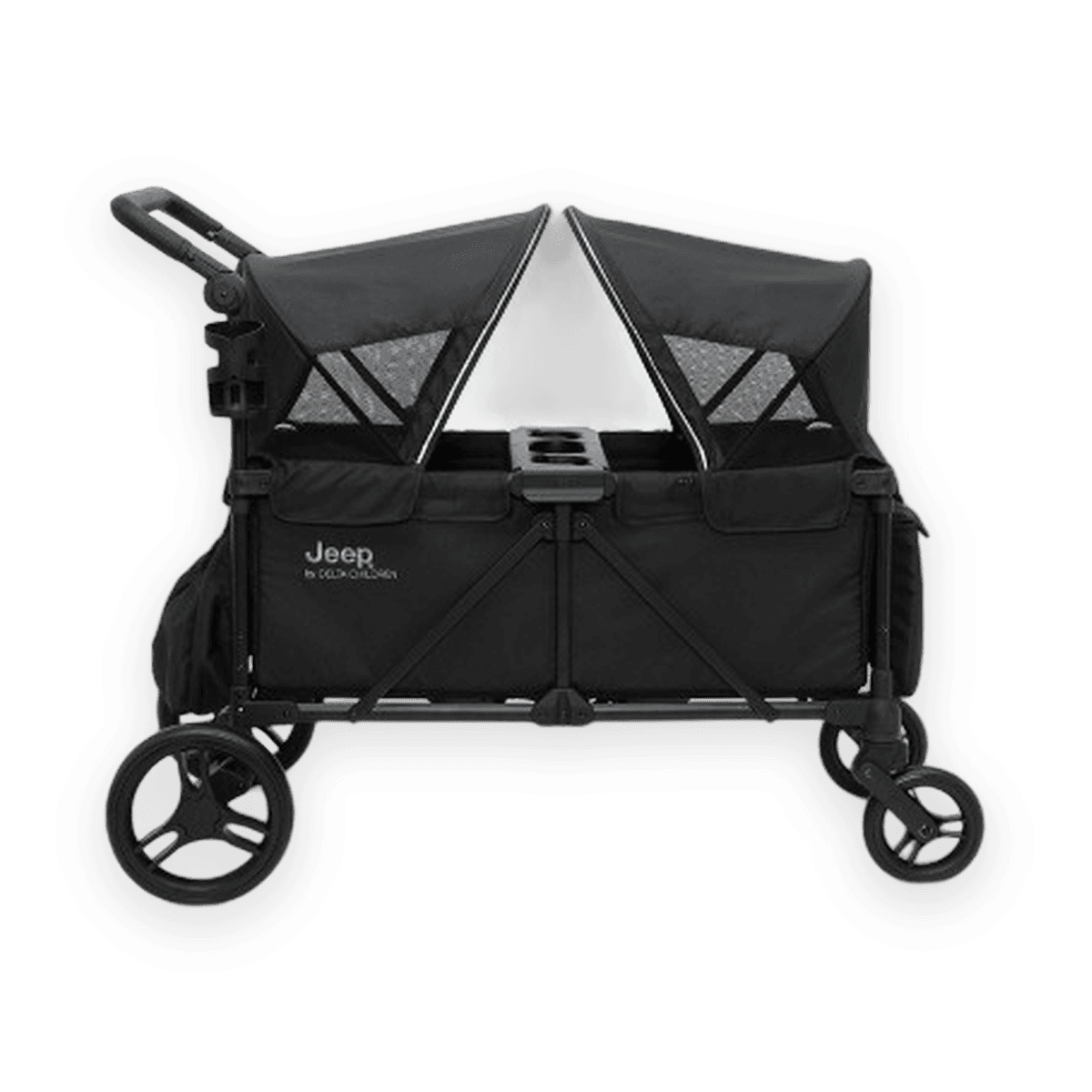
Product image via Target
Where to buy
Prices checked Sep 24, 2026- AmazonBest pickCheck price at Amazon
- TargetCheck price at Target
- Brand siteCheck price at Brand site
We may earn a commission from links on this page, at no extra cost to you. How this works.
15 min read · Reviewed by Huggle Hive Editorial Team, Parent-led product research team · Updated August 22, 2026
The short answer
If you have two kids past the newborn stage and you are tired of refereeing who gets the good stroller seat, the Jeep Evolve Stroller Wagon by Delta Children solves the problem cleanly. Two seats, two five-point harnesses, two adjustable canopies, and a handlebar you can push from behind or pull from the front. It carries JPMA certification and meets ASTM standards, and it earns an 8.3 Hive Score. The catch is the age rating: 9 months and up, so this is not the ride you bring home from the hospital.
What to know before you buy
- Seats two, with a five-point harness for each child and a foot-operated parking brake
- JPMA certified and built to meet ASTM standards, the two credentials that matter most in this category
- Age stage starts at 9 months, so it is a second-stage ride rather than a newborn one
- Handlebar adjusts through five positions and supports pushing or pulling, which is what makes a wagon usable in a crowd
- Folds to 26.2 in. L x 12.4 in. W x 36 in. H, narrow but tall
- Warranty is one year
Pros
- Two seats, each with a five-point harness, so both kids are restrained rather than just contained
- JPMA certified and meets ASTM standards, third-party verification against the industry safety standard
- Two adjustable canopies with breathable mesh inserts, so each child gets their own shade and airflow
- Leatherette handlebar with five positions, usable for pushing or pulling
- Real storage: expandable bag, multiple pockets, a parent cupholder, and a child tray with cup holders
- Delta Children describes the frame as rust-resistant and the tires as puncture-proof, so there is no tube to patch
- Travel-system compatible with a specific published list of infant car seats
- Folds down to 12.4 in. wide
Cons
- Age stage begins at 9 months, so it does not cover the newborn months on its own
- Versatility is the weakest sub-score at 3.3: no reversible seat, bassinet mode, or newborn mode in the verified specs
- Suspension, all-terrain wheels, and a canopy UPF rating are not listed in the specs, so do not assume them
- 36 in. tall folded, which is the dimension worth measuring against your cargo area
- One-year warranty
- Stroller weight and per-seat weight limits are not published in the specs available to us
Who should buy it, and who should skip it
Buy it if you have two kids in the 9-months-to-preschool window and your outings are the kind where a stroller becomes a fight. Zoo days, farmers markets, the long walk from the far parking lot, siblings who are 18 months apart and both still want to be carried by hour two. Two seats side by side with a harness each means nobody is riding on a lap or standing on a footboard.
It also suits the parent who hauls a lot. The expandable bag, the pockets, the parent cupholder, and the child tray with its own cup holders mean the diaper bag, the snacks, and your coffee all have a home. That sounds minor until you have pushed a double stroller with a tote bag looped over one wrist.
A wagon earns its keep the moment you need to pull instead of push. The five-position leatherette handlebar here is the feature that makes that a real option, not a marketing line.
Skip it if your baby is under 9 months and this is meant to be your only ride. The age stage is explicit, and no amount of padding changes what a manufacturer rates a product for. Skip it, too, if you want a stroller that converts through every phase of infancy. There is no reversible seat, bassinet compatibility, or newborn mode in the verified specs, and that gap is exactly what pulled the Versatility sub-score down to 3.3. And if you are shopping for a running stroller, look elsewhere: suspension and all-terrain wheels are not listed here.
| If this is you | Verdict |
|---|---|
| Two kids, both 9 months or older | Strong fit |
| One child, small trunk | Consider a single stroller instead |
| Newborn at home, no older sibling | Wrong stage, wait |
| Beach, park, and market regular | Strong fit |
| Runner or trail walker | Specs do not support it |
Performance
Is it safe for two kids?
The safety story here rests on three verified facts, and they are the right three. First, the wagon is JPMA certified and meets ASTM standards. The Juvenile Products Manufacturers Association runs a voluntary certification program in which a third-party lab confirms a product conforms to the relevant ASTM International safety standard for its category. That seal is not a guarantee against every accident, but it tells you the frame, the restraints, and the stability were checked by someone other than the brand that sells it.
Second, each seat has a five-point harness. This matters more in a wagon than parents expect. A three-point belt holds a child at the waist and shoulders only, and a determined toddler can lever their way up and out. Five points add a crotch strap that anchors the buckle low, which is what keeps a child from sliding down or standing while you are moving.
Third, the brake is foot operated. Get in the habit of stepping on it every single time you stop, not just on hills. The U.S. Consumer Product Safety Commission keeps stroller and carriage safety guidance current, and the recurring theme in its advice is simple: engage the brake whenever the stroller is not moving, and never leave a child unattended in it.
Safety basics scored 4.3 out of 5. The certification and the five-point restraints both push that number up. What is not in the verified specs is a GREENGUARD Gold listing for low chemical emissions, so we are not going to claim it either way.
Comfort and ride: what the two canopies actually do
Two canopies is the detail that separates this from a plain wagon. Each is adjustable and each has a breathable mesh insert. In practice that means the child on the sunny side gets shade while the other one gets a view, and neither is sealed into a hot fabric box on an August afternoon. Sun angle changes as you walk. One shared canopy forces a compromise; two do not.
What we cannot tell you is a UPF number, because none is published in the verified specs. Treat the canopies as shade, not as sunscreen. The American Academy of Pediatrics recommends keeping babies under 6 months out of direct sun entirely and using shade plus clothing plus sunscreen for older children, which is the right framework for any stroller canopy.
The handlebar is the other comfort piece, and it is doing double duty. Five positions accommodate caregivers of different heights, which is the difference between walking upright and hunching for a mile. Because the wagon supports pulling as well as pushing, you also get a way through narrow farmers market aisles and crowded museum corridors where a wide wagon in front of you is a liability. Comfort and ride landed at 4.5, the highest sub-score on the card, and the adjustable handlebar is the verified attribute doing most of that work.
Storage that matches how you actually leave the house
Here is the full published list: an expandable bag, what Delta Children calls tons of pockets, a parent cupholder, and a child tray with cup holders. Two things stand out. A parent cupholder is not a luxury when both your hands are on a handlebar. And a child tray with its own cup holders means snacks and water live within the kids' reach, which is the single cheapest meltdown prevention available to a parent on a long day out.
Wheels, frame, and the fold
Delta Children describes the tires as puncture proof and the frame as rust resistant. Read those as the manufacturer's claims, not as our findings, but understand why they are worth something. Puncture-proof tires mean no inner tube, so there is no pump to carry and no flat at the far end of the zoo. A rust-resistant frame is the spec that matters for beach sand, wet grass, and a wagon that lives in the garage through a damp winter.
The folded footprint is 26.2 in. L x 12.4 in. W x 36 in. H. That 12.4 in. width is genuinely narrow, which is what makes a compact fold worth advertising. The 36 in. height is the number to check. Measure your cargo area, and if you have a sedan with a small trunk opening, measure the opening too, not just the space behind it. Portability scored 4.4, anchored by the overall rating and the compact fold. Note that the stroller's weight is not published in the specs we have, so if you will be lifting this in and out solo, ask before you buy.
The travel-system question
The spec sheet lists travel-system compatibility with a specific set of infant car seats: Graco SnugRide Click Connect 30, 35, and 40, Evenflo Nurture, Evenflo Embrace, Britax B-Safe 35, and Chicco KeyFit 30. That list is unusually concrete, and it is good news if you already own one of those seats.
It also sits in tension with the 9-months-and-up age stage, and we would rather flag that than paper over it. Before you buy this expecting to click an infant seat into it for a newborn, contact Delta Children and confirm which adapter is required and what age the configuration is approved for. Do not assume the compatibility list overrides the age rating.
Who fits in it
The age stage is 9 months and up, and the seat count is two. Nine months is the point where most babies sit unsupported with confidence, which is the developmental milestone a wagon seat assumes. A younger baby who still slumps needs the recline and head support of a proper infant-stage stroller.
On the top end, wagons usually outlast strollers, because a 4-year-old who refuses a stroller will happily ride in a wagon with a sibling. Per-seat weight limits are not published in the specs we have. If you have a big preschooler, get that number from Delta Children before you count on years three and four.
What it costs to own
A wagon has no consumables, so the running cost is mostly about what fails and what it replaces.
On the failure side, the two parts that usually cost stroller owners money are tires and fabric. Puncture-proof tires remove the tube, the pump, and the patch kit from the equation entirely, which is a real saving over years of gravel paths. The seats and canopies are polyester over a metal and plastic frame, so ordinary maintenance is spot cleaning and letting things dry fully before the wagon goes back in the garage. A rust-resistant frame is what protects that garage storage habit.
The warranty is one year. That is on the shorter side, so two habits pay off: register the product when it arrives, and keep your receipt somewhere you will find it in eleven months.
The bigger value math is a replacement question. This is a two-seat stroller and a hauling wagon in one product. If the alternative in your cart is a double stroller plus a separate beach or sports wagon, price the Evolve against both together rather than against the stroller alone. That framing is where its Value sub-score of 3.8 makes the most sense: a middling number in isolation, better when it is doing two jobs.
Prices on strollers move with season and stock, so check the current listing in the availability section below rather than trusting any number you read in a review, including ours.
How it compares to other two-kid options
We do not have a directly matched peer set for this wagon, so rather than invent competitor specs, here is the honest category comparison you should be running in your head.
Versus a side-by-side double stroller. Side-by-sides usually give you deeper reclines and often a from-birth configuration, which this wagon does not have. What they rarely give you is the ability to pull. The Evolve's five-position handlebar and pull mode are the advantage on crowded ground, and the child tray with cup holders is not something most side-by-sides include.
Versus a tandem or inline double. Inline strollers are narrower, which is their whole argument, and a folded width of 12.4 in. here narrows the gap once the wagon is down. The catch with tandems is that one child rides behind the other, usually with a worse view and less shade. Two independent adjustable canopies is a meaningfully better arrangement for two kids who both want to see out.
Versus a basic beach or sports wagon. Plain wagons cost less and haul more gear, but most are not strollers. They lack five-point harnesses, they are not JPMA certified as juvenile transport, and their handles are made for towing cargo rather than pushing children. If your load is kids rather than coolers, the restraint system and the certification are what you are paying for here.
For more side-by-side options, browse our full stroller reviews and the Delta Children brand page.
How we scored it
The Hive Score of 8.3 out of 10 is the average of five sub-scores, each derived from the verified attributes rather than written by hand. Here is how each one landed.
Comfort and ride, 4.5. The top mark on the card. The five-position adjustable leatherette handlebar is the driver, since handlebar adjustability is the attribute most directly tied to how a stroller feels over a long walk. Suspension, an all-terrain designation, and a canopy UPF rating are not present in the specs, which is what keeps this from going higher.
Portability, 4.4. Strong, on the strength of a compact fold measuring 26.2 in. L x 12.4 in. W x 36 in. H. There is no published weight, no confirmed one-hand fold, and no self-standing claim in the specs, so this score reflects the fold dimensions and the overall rating rather than a full portability picture.
Safety basics, 4.3. JPMA certification plus ASTM conformity plus a five-point harness in each seat is close to the full set of things we look for. A GREENGUARD Gold listing would be the remaining lift, and it is not in the verified data.
Value, 3.8. Slightly above the middle. Without a price tier in the verified data, this sits near the category baseline and gets nudged by the overall rating. The one-year warranty is the factor most likely to be holding it back.
Versatility, 3.3. The clear laggard, and honestly so. Two seats and travel-system compatibility both help, but there is no reversible seat, no bassinet compatibility, and no newborn mode, so the wagon covers one life stage well rather than several. If you want a stroller that morphs from birth through preschool, this is the sub-score to weigh most heavily. Our full scoring methodology explains how each dimension is derived.
Frequently asked questions
Can a newborn ride in the Jeep Evolve Stroller Wagon?
No. The age stage is 9 months and up. The spec sheet does list travel-system compatibility with several infant car seats, but confirm the required adapter and the approved age directly with Delta Children before planning on a newborn configuration.
How many kids does it hold?
Two. Each seat has its own five-point harness. Per-seat weight limits are not published in the specs available to us, so request that number from Delta Children if you have an older preschooler.
Is it JPMA certified?
Yes. It is JPMA certified and built to meet ASTM standards, meaning a third party verified it against the industry safety standard for its category rather than the brand self-certifying.
Which car seats work with it?
The published compatibility list covers the Graco SnugRide Click Connect 30, 35, and 40, the Evenflo Nurture, the Evenflo Embrace, the Britax B-Safe 35, and the Chicco KeyFit 30. Confirm the adapter with Delta Children for your specific seat.
Will it fit in my trunk?
Folded, it measures 26.2 in. long, 12.4 in. wide, and 36 in. tall. The width is easy. The 36 in. height is the number to measure against your cargo area and your trunk opening.
Can you pull it instead of pushing it?
Yes. The adjustable leatherette handlebar has five positions and supports pushing or pulling, which is what makes it workable in narrow aisles and crowds.
What is the warranty?
One year. Register the wagon when you get it and keep your receipt, since a one-year window goes quickly.
Does it come with cup holders?
Yes. There is a parent cupholder plus a child tray with its own cup holders, alongside an expandable bag and multiple pockets.
Where to buy it
Stroller pricing shifts with season and stock, so compare current listings before you commit, and check whether a bundle includes the car seat adapter you need.
Bottom line
The Jeep Evolve Stroller Wagon is a focused product that does one job well: moving two kids, their snacks, and your stuff, comfortably, with proper restraints and third-party safety certification behind it. The five-position push-pull handlebar and the two independently adjustable mesh canopies are the features that make it better than a generic wagon, and the storage list is genuinely thought through. Its weakness is range. At 9 months and up, with no bassinet or reversible-seat mode, it is a second-stage ride rather than a birth-to-preschool one. If your two kids are already sitting up and your outings keep ending in a carry, this is an easy recommendation at an 8.3.
Delta Children Jeep Evolve Stroller Wagon
See prices