
Baby Trend Quest Plus 3-in-1 Stroller Wagon
Price verified Sep 13, 2026 · lowest in 90 days $319.99
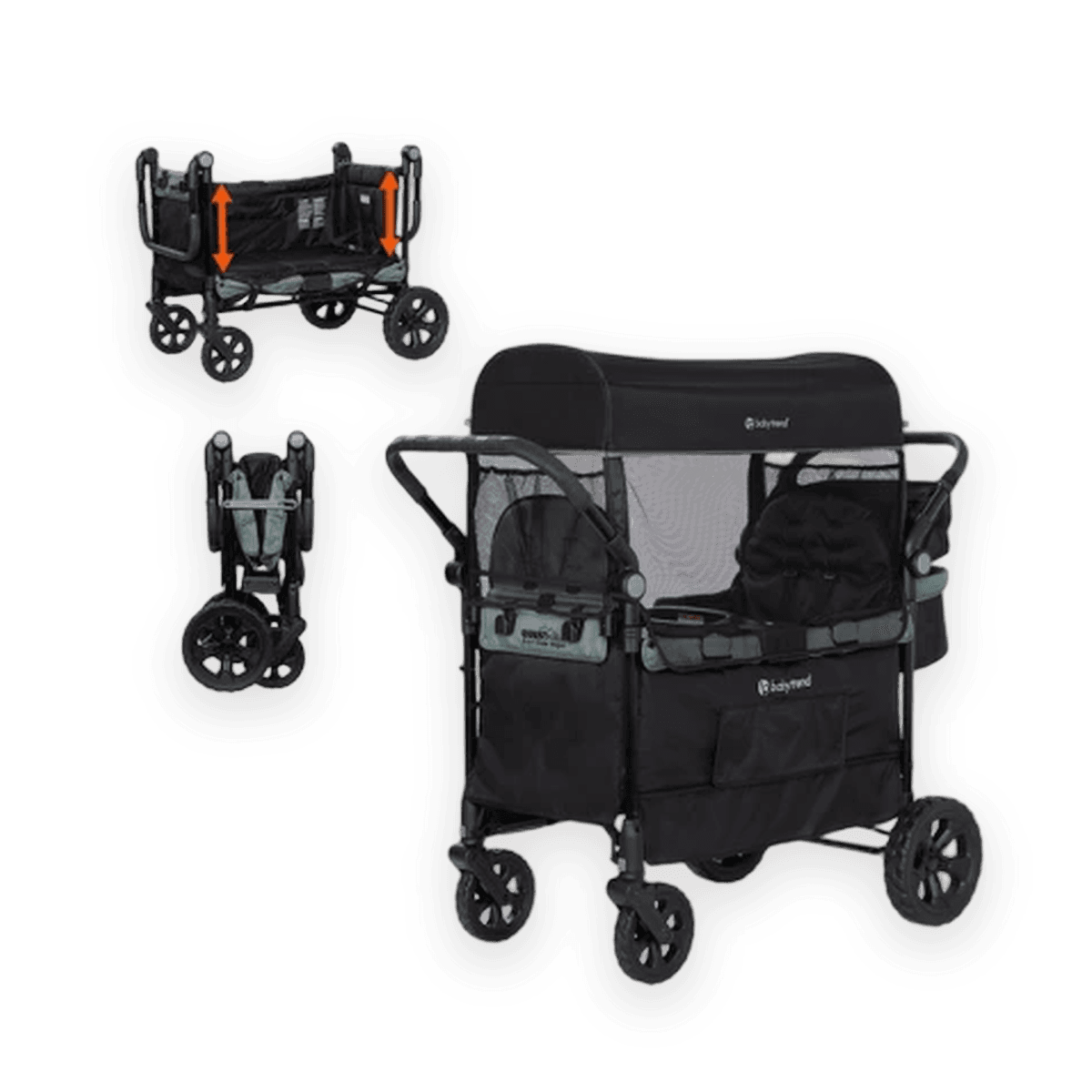
Product image via Target
Where to buy
Prices checked Sep 13, 2026- TargetCheck price at Target
- Brand siteCheck price at Brand site
We may earn a commission from links on this page, at no extra cost to you. How this works.
15 min read · Reviewed by Huggle Hive Editorial Team, Parent-led product research team · Updated August 2, 2026
Baby Trend's Quest PLUS 3-in-1 Stroller Wagon answers one specific question well: how do you move two kids, a cooler bag, and everyone's water bottles across a park without carrying any of it? It seats two children in five-point harnesses, rolls on solid PU tires Baby Trend rates for all terrain, and can be pushed from behind or pulled from the front. What it does not do is start at birth. Baby Trend rates it for 6 months and up, so it sits alongside an infant stroller rather than replacing one.
Our scorecard
How the Hive Score works- Portability
- 4.2
- Safety basics
- 3.9
- Comfort & ride
- 4.4
- Versatility
- 2.8
- Value
- 3.0
Scores blend each product's verified specs with its overall owner rating, weighted the same way for every stroller. Learn more about our evaluation framework.
The quick read
- Two removable seats, each with a five-point harness, so both kids ride strapped in instead of free-sitting
- The handle pushes and pulls, and adjusts to six heights, which matters when two adults of different heights trade off
- Solid PU tires with an all-terrain rating: nothing to inflate, nothing to pump
- Rated from 6 months and up, so it skips the infant-carrier stage entirely
- One-hand fold down to 14 inches deep, but the frame is still a two-hand lift into a car
- Baby Trend states the wagon meets ASTM standards
Pros
- Two removable seats, each with a five-point harness, plus a foot brake
- Handle works from either end and sets to six heights, so tall and short parents both get a comfortable push
- Solid PU tires rated for all terrain, with no valves, no pump, and no pinch flats
- The side bar drops to make a bench, so kids can climb in on their own instead of being lifted over a rail
- Real cargo capability: a flip-over basket that mounts front or rear, storage pockets, and a child tray with two cup holders and a center console for each seat
- One-hand fold, useful when you are holding a toddler with the other arm
- Roll-up zippered side shade with air-flow netting for sun and bugs
Cons
- 39 pounds empty is a genuine lift into a tall trunk or up a flight of apartment stairs
- Rated from 6 months, so you still need a separate stroller for the infant-carrier stage
- Baby Trend publishes maximum child weight as one 110-pound figure rather than a per-seat limit, so you have to plan around the total
- 27 inches wide is a lot of wagon for narrow store aisles, tight doorways, and crowded sidewalks
- Solid tires mean no flats, but they also pass more of the bump through to the kids than air tires would
Who is this wagon for?
You want this if your outings are outdoors and involve two children who can sit up on their own. Farmers markets, zoo loops, beach paths, soccer sidelines, campgrounds, and the long walk from overflow parking to the fair gate. Wagons win in those places because kids get in and out constantly, and because you need somewhere to put the stuff that a stroller basket cannot swallow.
You should skip it if you have a newborn. Baby Trend rates the Quest PLUS for 6 months and up, which lines up with the point at which most babies have steady head and trunk control. It does not carry an infant car seat, so the first half-year still belongs to your regular stroller.
Skip it, too, if your daily life is indoor and narrow. A wagon this wide is awkward in grocery aisles, tight elevators, and older buildings with slim doorways. And if you park in a compact garage spot or street-park with a walk to your door, be honest with yourself about lifting a 39-pound frame twice per outing before you commit.
If most of your walking happens on pavement between shops, buy a double stroller. If most of it happens on grass with a cooler in tow, buy the wagon.
The specs at a glance
| Spec | What Baby Trend lists |
|---|---|
| Type | Two-seat stroller wagon |
| Age stage | 6 months and up |
| Max child weight | 110 lb (published as a single figure) |
| Wagon weight | 39 lb |
| Open size | 49 in H x 27 in W x 27 in D |
| Folded size | 31.5 in H x 27 in W x 14 in D |
| Seats | 2, removable, five-point harnesses |
| Wheels | Thick PU, all-terrain |
| Brake | Foot |
| Handle | Push and pull, six heights |
| Fold | One-hand |
| Frame | Metal |
| Storage | Flip-over basket (front or rear), storage pockets, child tray with two cup holders and center consoles |
| Certification claim | Meets ASTM standards |
How does it actually perform?
Does it handle grass and gravel?
This is the reason to buy a wagon instead of a double stroller, and it is where the Quest PLUS is strongest. Baby Trend describes thick PU tire wheels and rates the wagon for all terrains. Solid polyurethane wheels do not go flat from a pinch or a puncture the way air-filled tires can, which removes the one maintenance job that quietly kills a lot of jogging strollers: the slow leak you discover on the morning you are already late.
The trade-off with any solid tire is compliance. Air acts as a spring, and solid material does not, so more of a curb edge or a rutted trail comes through the frame. On grass, packed dirt, gravel, and boardwalk, that is a fair exchange. On a bumpy sidewalk with a sleeping toddler, an air-tire stroller is smoother.
Weight helps here in a way it does not help anywhere else. A heavy metal frame tracks straighter and gets pushed around less by an uneven surface, which is part of why the comfort and ride subscore lands where it does.
How safe is the seating?
Baby Trend lists two removable seats, each with a five-point safety harness. That is the specification to look for in a wagon, and it separates a stroller wagon from a garden cart with cushions in it. Five points hold at both shoulders, both hips, and the crotch, so a child who stands up mid-pull is held rather than launched. A toddler who has learned to unclip is a different problem, and no harness design solves that one for you.
Braking is a foot brake, the standard for this class. Get in the habit of setting it every time you stop on any grade, not just steep ones, because a loaded wagon carries a lot of momentum once it starts moving.
Baby Trend states that the wagon meets ASTM standards. For context, the U.S. Consumer Product Safety Commission enforces a federal safety rule for carriages and strollers that is built on the ASTM F833 standard, covering things like restraint integrity, brake performance, and stability. On the age question, the American Academy of Pediatrics is the reference point for when a baby has the head and trunk control that upright seated gear assumes, which is the reasoning behind a 6-month rating like this one.
The side bar trick
One feature deserves its own beat. Baby Trend says the side bar drops down to turn the wagon into a bench, so children can get in during a picnic instead of being lifted over the rail. If you have a 3-year-old who insists on doing it herself, this is the difference between a 10-second boarding and a two-minute negotiation. It also saves your back on the twentieth in-and-out of the afternoon, which is the realistic count at a zoo.
Sun, airflow, and snacks
The side shade rolls up and secures with a zipper, and Baby Trend describes air-flow netting on the wagon. Netting matters more than parents expect: it keeps a canopy-covered wagon from turning into a still, hot box on a windless day, and it puts a barrier between a sleeping toddler and whatever is buzzing around the picnic. Treat any shade like shade, not like sun protection, and keep the hat and sunscreen routine going.
Then there is the snack infrastructure. The child tray gives each kid two cup holders and a center console, and Baby Trend lists storage pockets plus a flip-over basket that attaches to the front or the rear. The reason to care is not luxury, it is the number of stops per outing. Every item that has a home on the wagon is one you are not holding, and one your child cannot ask you to retrieve from under the seat while you are pulling uphill.
Pushing versus pulling
The handle both pushes and pulls and adjusts to six heights. Six is a generous number, and the practical benefit shows up when two caregivers of different heights swap off. Pulling gives you better control on a rough path and lets you watch where you are going. Pushing keeps the kids in front of you in a crowd. Having both, on a handle that fits your arm, is the kind of small thing you notice on hour three.
A note on width: at 27 inches across, the wagon is close to the width of a side-by-side double stroller. Plan on outdoor paths and standard doorways, not boutique aisles.
Fit and sizing: who fits, and for how long?
Baby Trend rates the Quest PLUS from 6 months and up, with a maximum child weight of 110 pounds. That 110-pound figure is published as one number rather than a per-seat limit, so the safe way to plan is to treat it as the total the wagon is rated to carry across both seats.
Read that way, the runway is long. Two kids at 35 pounds each is 70 pounds, comfortably inside the rating, and most families age out of a wagon socially (the older child would rather walk) long before they hit a weight ceiling. Open height is 49 inches at the handle, which is the number that determines whether pushing feels upright or hunched for a taller parent.
The seats are removable, and that is the sizing feature people underuse. Pull one seat for a single rider plus a large cargo run, or pull both to haul beach gear when the kids are walking. The wagon becomes two different vehicles depending on what the day needs.
Getting it into your car
Here is the honest part. The wagon weighs 39 pounds and folds to 31.5 inches high, 27 inches wide, and 14 inches deep. The fold is one-handed, which is a real convenience when your other arm is occupied, and 14 inches of folded depth is slim enough to stand against a garage wall or slide into a trunk beside a stroller.
The weight is a two-hand job. If your vehicle has a high load floor, or you carry it up stairs to an apartment, do a dry run before the first big outing. Families who leave the wagon in an SUV or a minivan between uses barely think about it. Families who lift it in and out of a sedan trunk every weekend think about it every time.
What you are paying for, in one list:
- Two harnessed seats instead of one seat and a standing platform
- Wheels rated for terrain a stroller wheel would fight, with no inflation to maintain
- A handle that works from both ends, at six heights
- Cargo capacity: front or rear basket, pockets, and a per-child tray with cup holders
- A drop-down side bar that lets kids board themselves
- A metal frame and a manufacturer statement of ASTM compliance
How does it compare to the alternatives?
Against a side-by-side double stroller, the Quest PLUS trades recline-and-nap comfort for terrain and cargo. Double strollers usually give you deeper recline options and a lower center of gravity for city curbs, and they fit through doorways more predictably. This wagon gives you a bench that kids board themselves, tires that shrug off gravel, and space for a cooler. If naps on the move are the core use case, the stroller wins. If arrivals and departures at outdoor venues are the core use case, the wagon wins.
Against a single stroller with a ride-along board, the wagon costs you compactness and gains you safety structure. A board keeps an older sibling standing and unrestrained; two five-point harnesses do not. For long days and long distances, harnessed seating is the better setup, and it is not close.
Against a plain pull wagon from the hardware aisle, the difference is the entire safety and comfort package: harnesses, a foot brake, a shade with netting, an adjustable push-and-pull handle, and a manufacturer statement of ASTM compliance. That comparison is the one worth remembering if you are tempted by a cheaper cart.
If you are still weighing formats, our stroller reviews and the best strollers guide walk through the same decision across more configurations.
How we scored it
Comfort and ride, 4.4. The highest subscore, and it is earned by the terrain package rather than by plush trim. All-terrain wheels, a six-height adjustable handle that fits different adults, and a metal frame with enough mass to track straight all point the same direction. The ceiling on this dimension is the solid tire itself, which does not absorb chatter the way an air tire does.
Portability, 4.2. Judged against other two-seat wagons rather than against an umbrella stroller. The one-hand fold and the 14-inch folded depth do the heavy lifting on this score: it collapses without a two-person routine and stores flat. The frame weight is what keeps it from scoring higher, and it is the single thing most likely to change your mind at the curb, so weigh it against your car and your stairs.
Safety basics, 3.9. This dimension is held to the strictest evidence of the five, and it starts a notch below the others by design. Supporting it here: five-point harnesses on both seats, a foot brake, a metal frame, and Baby Trend's statement that the wagon meets ASTM standards. It sits below the ride and portability scores because the claim set is the manufacturer's own rather than an independent certification we can point to.
Versatility, 2.8. The lowest score, and the fairest criticism of the wagon. It builds up from a low base, and the two-seat count is what lifts it. What is missing is stage coverage: Baby Trend rates it from 6 months, so it does not carry a newborn or an infant car seat, and it is not part of a travel system. This is a second vehicle for a specific season of family life, not a birth-to-preschool answer.
Value, 3.8. This is judged on hardware per dollar in the wagon class: two harnessed seats, all-terrain wheels, a dual-direction six-height handle, a drop-down bench bar, a shade with netting, and three separate storage systems is a dense feature list for one product. We are not quoting a price in this review, because wagon prices swing hard with sales and configuration, so check the current listing and re-run the math against a double stroller before you decide the deal is good.
The method behind these numbers, and what each dimension is anchored to, is on our review methodology page.
Common questions
What age is the Baby Trend Quest PLUS stroller wagon for?
Baby Trend rates it for 6 months and up. That aligns with the stage when most babies have the head and trunk control that upright seated gear assumes. It is not a newborn product, so plan on keeping a separate stroller for the infant-carrier months.
How much weight can it carry?
Baby Trend lists a maximum child weight of 110 pounds. That is published as one figure rather than a per-seat limit, so treat 110 pounds as the total across both seats when you plan.
Do the tires need to be inflated?
No. Baby Trend describes thick PU tire wheels, which are solid rather than air-filled. They do not go flat from a pinch or a puncture the way pneumatic tires can, so there is no pump to keep in the trunk. The trade is a slightly firmer ride over bumps.
Can one parent fold it and load it alone?
Folding, yes: it has a one-hand fold and collapses to 14 inches deep. Loading is the harder half, because the frame weighs 39 pounds. Most people manage it two-handed into a van or SUV; a high sedan trunk or a set of stairs is where it gets tiring.
Is it safe for two kids to ride at once?
That is what it is designed for. It has two removable seats, each with a five-point safety harness, plus a foot brake, and Baby Trend states the wagon meets ASTM standards. Set the brake at every stop and keep both harnesses buckled while the wagon is moving.
Will it fit through a standard doorway?
Open, it is 27 inches wide, which clears a typical 30-inch to 32-inch interior door but is tight in older buildings, narrow shop aisles, and crowded elevators. It is happiest outdoors.
Can I use it as a cargo hauler without the kids?
Yes. Both seats are removable, which opens up the cargo area, and the flip-over basket attaches to the front or the rear. That makes it useful for beach days and camp setups once your kids would rather walk.
Where to buy it
The bottom line
The Quest PLUS is a good answer to an outdoor problem. Two harnessed seats, wheels that handle terrain without maintenance, a handle that pushes and pulls at six heights, and storage in three places add up to a wagon you can take somewhere real without a second trip to the car. The comfort and ride score reflects that; the versatility score reflects the limit.
Buy it if your kids are past 6 months and your weekends happen on grass. Skip it if you need newborn coverage, if your walking is mostly indoors and narrow, or if a 39-pound lift at both ends of every outing is a fight you would rather not have.
Baby Trend Quest Plus 3-in-1 Stroller Wagon
See prices